 i'm not even going to try writing anything about The Third Man, especially after such a long break from movie blogging. it's strange how the inconsequential films are easier to write about, but when it comes to the stuff that floors me, i can't express anything to my satisfaction. maybe that's what makes it art? or maybe i'm just a little too aware that my own impressions of masterworks are pretty banal in the shadow of the volumes already written? painful self-awareness, though, is a small price to pay for exposure to brilliance, on both the screen and the page, and The Third Man, in its studied, quietly suspenseful pursuit, is brilliance itself.
Monday, September 24, 2007
carol reed's THE THIRD MAN (1949)
i'm not even going to try writing anything about The Third Man, especially after such a long break from movie blogging. it's strange how the inconsequential films are easier to write about, but when it comes to the stuff that floors me, i can't express anything to my satisfaction. maybe that's what makes it art? or maybe i'm just a little too aware that my own impressions of masterworks are pretty banal in the shadow of the volumes already written? painful self-awareness, though, is a small price to pay for exposure to brilliance, on both the screen and the page, and The Third Man, in its studied, quietly suspenseful pursuit, is brilliance itself.

nancy meyers' THE HOLIDAY (2006)
 it's obvious that Meyers thinks her concept and script for The Holiday are much funnier than they actually are, which hobbles the film early on; that's not to speak against the scenario, which is a fine setup for low-key romantic comedy, but the miscalculations involved in playing it so broadly end up reflecting poorly on the whole thing. even worse is the pacing, which lingers carelessly on the prettier of its two couples despite the fact that the other pairing (saddled in their limited screen time with a generally useless subplot concerning an elderly screenwriter) are much more likable. no one really asks for movies like this to be great, but sloppy storytelling is a lot harder to forgive when you're working with such staid framework.
james mangold's 3:10 TO YUMA (2007)
 the early buzz readied me for the revival of the western, and though Mangold's remake doesn't necessarily dance hoodoo around The Duke's grave, it's still a good time at the movies, full of fine performances and genuine thrills.
Wednesday, September 05, 2007
two days, three nights in the riviera for seven bucks: an impromptu film festival
well, it’s finally here. after years of speculation and financial aggravation, a convoluted $14.85 million collaboration between Regal Entertainment Group, private investors, the City of Knoxville and its tax codes has yielded the newest feather in Gay Street’s cap: the Regal Riviera Stadium 8. combining a faux-classic (but still classy, haters be damned) veneer with eight well-appointed auditoriums, the Riviera is downtown Knoxville’s next big hope in its rapid crawl towards its ever-idealized revitalization. first a liquor store, and now this!
the lack of a movie theater convenient to downtown has long been conspicuous. it’s no secret, after all, that the primary demographic for contemporary cinema ranges from late adolescence to early thirties, which falls neatly in line not only with the increasing gentrification of downtown and its outlying neighborhoods but also with the 800-lb gorilla separating it from West Knoxville: the 25,000 attendees of the
University Of Tennessee, previously served most conveniently in their moviegoing needs by the screens at West Town Mall. considering the thousands of those lacking either personal transportation or the parking deathwish that is Leaving Campus On A Weeknight, it’s little wonder that so many college students are content to BitTorrent shitty bootlegs and huddle around a 19” monitor. combined with the theater industry’s apparent embargo with South Knoxville, it’s actually kind of a shock that it took so long to make this happen.
but it did happen, amidst much ado. state grants were handed out, preservationists were mollified, architecture was criticized, et cetera. and now the Riviera is open, and the focus drifts toward the practical. is it a nice theater? (not that it matters, beyond our tax dollars’ role in it – go to Wynnsong if you don’t believe me.) more importantly, what sort of movies will they be showing? the post-opening schedule wasn’t made available until a few days beforehand, but late in July Regal announced that the Riviera would be prefacing its Grand Opening with three themed days of $1 films and concessions with the proceeds from each day going to a different charity. a similar pre-opening event at Pinnacle yielded screenings of It’s A Wonderful Life, Top Gun, the first two Indiana Jones movies, and the Lord Of The Rings trilogy, so film fans all over Knoxville held their breaths. could this be a rare chance to show Regal that Knoxville might be just as interested in seeing the occasional favorite of yesteryear as the standard-lowering late summer nonsense of today?
the answer: an enthusiastic no! the bow of Regal’s upscale downtown moviehouse apparently didn’t merit such crowd-pleasing, theater filling fare, as its programmers opted instead for easy choices like Spider-Man 3 (not even as old as some of the charity days’ supplementary second-run films, and certainly not old enough for anyone to have forgotten how disappointing it was) and Tim Allen’s Yuletide classic Christmas With The Kranks.
Regal Marketing VP Russ Nunley was generous enough to assuage my own resulting Krankiness with assurance that past corporate experience actually shows that Riviera’s three daily themed films is fairly generous for an eight-screen theater, and that familiarity sells more tickets than prestige. “during the preview events our goal is to entice as many people as possible to see the new facility in the hopes that they enjoy the experience and then tell family and friends to spread the word,” Nunley explains.
so what’s a snooty film fan to do, stuck with two days off to devour sixteen hours worth of favorites from the lauded Late Spring Of 2007? the prospect of all that $1 Golden Flavored Topping-y popcorn, sugary soda and air-conditioning was hard to pass up, so why not? for the price of one normal movie ticket I could treat myself to a gloriously run-of-the-mill film festival, and see if there were any pleasures to be had.
TUESDAY – Vigilante Justice & Dead Daddy Issues
i anticipated the sell-out crowds that greeted the Pinnacle’s charity festivities, especially given the day’s “Superheroes For United Way” theme, showcasing recent hero-flicks Batman Begins, Superman Returns, and the aforementioned Spider-man Stumbles (personal wishlist: The Incredibles, X-Men 2, and…well, Batman Begins) so I was surprised to find no line outside the Riviera. a quick trip to the box office and concessions, though, gave me enough time to take in the Riviera’s lovely (though somehow surprisingly small) lobby, which features as its centerpieces three blown-up photographs of Gay Street from the 20s to the 40s, each of them revealing a different angle of the original Riviera Theatre, which occupied the very same space from 1920 until it was torn down in 1988 after a decade of inactivity.
 i decided to kick off my Rivierafest with DJ Caruso’s Disturbia, the story of a young man (Transformers’ Shia LaBeouf) whose erratic behavior after witnessing his father’s death lands him on house arrest just in time to spend his summer vacation spying on the neighbors, including a beguiling girl next door and a yuppie who may just be a serial murderer. this is, of course, a loose variation on Rear Window, with a little of The ‘Burbs thrown in for good measure; such a pedigree would render most teen-centric remakes all but stillborn, but while Disturbia certainly lacks their respective brilliance and levity, it carries itself confidently as a thriller and inhabits its reimagined story with an endearing sincerity. both LeBouf and villain David Morse (in a lamentably rare meaty role) turn in fine performances, and though it could have done with a bit more ambiguity where Morse’s character was concerned, Disturbia is admittedly one of the finer B-thrillers I’ve seen lately, and started out the day on a note of pleasant surprise.
 second was Christopher Nolan’s Batman Begins, in an even smaller auditorium than Disturbia. (I’d come to find out that while several of the Riviera’s theaters are quite sizable, boasting the highest overall seat-to-screen ratio in town, the ones along the western wall are as small as a cozy 109 seats.) i’d been impressed with the film when I first saw it, and though the novelty of Batman-taken-seriously dulls somewhat upon a repeat viewing, it’s still probably the superhero genre’s most successful work where psychological, emotional and procedural realism are concerned. Nolan shakes every last detail out of how a troubled billionaire playboy might go about turning himself into a creature of fear and justice, and sews them back into a creatively structured origin story that skimps on neither the pathos nor the horror that a good Batman film deserves. sure, they didn’t quite nail the cowl, and Katie Holmes fearlessly proves her own uselessness amid an otherwise perfect cast, but Batman Begins still rewrote the book on how to treat an icon to a worthy character study.
 Superman Returns, on the other hand, suffers much worse upon a second viewing, and following a screening of Batman doesn’t help. approaching the other half of the World’s Finest with a realist bent surely wouldn’t have done the material any favors, but neither does Bryan Singer’s choice to wallow sloppily in Superman’s assumed iconic glow, leaning far too heavily on the continuity of Richards Donner & Lester’s first two Superman films and all but forgetting to shape the rest of the film’s lazy emotional meandering into a compelling story. Kevin Spacey strikes a smart, faithful tone as archvillain Lex Luthor, but Singer sadly refuses to follow his lead, relegating him to a dramatically inert plot while dedicating all of his energy to making everyone else flat and uninteresting, except for Lois Lane, who is well-developed insomuch as she’s quite deeply callow and unsympathetic.
WEDNESDAY – Advice From Disinterested Screenwriters On Being A Father
 after battling a much direr parking situation at the State Street garage, I arrived at the Riviera just in time for the opening credits of Tom Shadyac’s Evan Almighty, shown in a surprisingly large auditorium befitting the film’s epic commercial and creative failure. the facile $200 million religious pander-fest revisits Bruce Almighty’s Evan Baxter (a bored, paid Steve Carrell) as God badgers him into building an ark in hopes of strengthening the bond with his three anonymous sons, with the downplayed side effect of saving two of every animal from a watery holocaust centered in suburban DC. sure, acknowledging the implied genocide of its central conceit would be kind of a comedy killer, but, then, so is the script, which is so bad that multiple scenes between Wanda Sykes, Steve Carrell, John Michael Higgins and Jonah Hill rarely even manage a laugh. Evan Almighty will no doubt find a second life as last-minute entertainment at junior high youth group lock-ins, but as a comedy (let alone the most expensive one ever made) it’s pretty worthless.
 wednesday’s theme was “Christmas In August”, but none of the choices appealed to me save for Elf, which I’m content to wait until Christmas to watch again. (wednesday wishlist: A Christmas Story, Home Alone, and Die Hard.) instead, I moved on to the third installment of a franchise for which I harbor an intense distaste, but have somehow managed to see all three of; crass and unambitious, Shrek The Third is little different than its precursors, bouncing back and forth between unfunny children’s humor and unfunny adult humor in an insulting half-simulation of archrival Pixar’s warm and witty, genuinely family-friendly aesthetic. thankfully, unexplained technical issues repeatedly halted the get-em-while-they’re-young standards-lowering, and I must say that listening to the little oracle behind me rain spoilers of minor physical humor down on her sister was just as compelling, and twice as funny, as seeing it play out onscreen.
 Disney’s Meet The Robinsons, however, proved a maniacally weird antidote to Shrek, despite a ten-minute wait for them to start up the projector. i regret missing it in 3-D earlier this year, but even in two dimensions it impresses, thanks primarily to its swift spirit and madcap good-naturedness, and even though it sags in places it brings a sort of restless originality to Disney’s diminishing animated efforts.
THURSDAY – Hud
 i was only able to see one film on Thursday, but it was the one I would have otherwise gone out of my way to see. Martin Ritt’s modern western Hud was presented alongside Steel Magnolias and Walk The Line under the guise of “WIVK Day On Theatre Row”, showcasing films with local ties (wishlist: James Agee’s Night Of The Hunter and Charade, the first film shown when the New Riviera was reopened in 1963), and was undoubtedly the prize of the Riviera’s pre-opening event. starring Paul Newman and Knoxville native Patricia Neal, the film takes a hard look at a family of latter-day cowboys, paying special attention to the way teenaged orphan Lonnie (Brandon DeWilde) tries to reconcile his respect for his grandfather (Melvyn Douglas) and his fascination with his callous, cavalier uncle Hud (Newman). like the other six films (which don’t even include Knocked Up, which I’d already seen twice), Hud draws heavily on themes of fatherhood, but doesn’t succumb to any of the sentimentality; no, Lonnie never seems preoccupied with his father, but studies the two men in his life carefully, finding out just for himself just who he wants to be.
Hud sees itself to a dour, cynical ending, the likes of which only come up these days in finicky indie flicks. (it’s a testament to Ritt and his film that Hud is nonetheless considered a classic.) but as the lights went up at the end and the projectionists no doubt prepared to replace the black and white dinosaur with a print of Balls Of Fury, there was a definite feeling among the audience (the largest I’d been a part of in three days) that we’d all shared a satisfying experience, taking in great cinema with the wonder they surely felt in that very spot eighty years earlier, before movies were just marketing, before everything was so crass.
(from the KNOXVILLE VOICE)
the lack of a movie theater convenient to downtown has long been conspicuous. it’s no secret, after all, that the primary demographic for contemporary cinema ranges from late adolescence to early thirties, which falls neatly in line not only with the increasing gentrification of downtown and its outlying neighborhoods but also with the 800-lb gorilla separating it from West Knoxville: the 25,000 attendees of the
University Of Tennessee, previously served most conveniently in their moviegoing needs by the screens at West Town Mall. considering the thousands of those lacking either personal transportation or the parking deathwish that is Leaving Campus On A Weeknight, it’s little wonder that so many college students are content to BitTorrent shitty bootlegs and huddle around a 19” monitor. combined with the theater industry’s apparent embargo with South Knoxville, it’s actually kind of a shock that it took so long to make this happen.
but it did happen, amidst much ado. state grants were handed out, preservationists were mollified, architecture was criticized, et cetera. and now the Riviera is open, and the focus drifts toward the practical. is it a nice theater? (not that it matters, beyond our tax dollars’ role in it – go to Wynnsong if you don’t believe me.) more importantly, what sort of movies will they be showing? the post-opening schedule wasn’t made available until a few days beforehand, but late in July Regal announced that the Riviera would be prefacing its Grand Opening with three themed days of $1 films and concessions with the proceeds from each day going to a different charity. a similar pre-opening event at Pinnacle yielded screenings of It’s A Wonderful Life, Top Gun, the first two Indiana Jones movies, and the Lord Of The Rings trilogy, so film fans all over Knoxville held their breaths. could this be a rare chance to show Regal that Knoxville might be just as interested in seeing the occasional favorite of yesteryear as the standard-lowering late summer nonsense of today?
the answer: an enthusiastic no! the bow of Regal’s upscale downtown moviehouse apparently didn’t merit such crowd-pleasing, theater filling fare, as its programmers opted instead for easy choices like Spider-Man 3 (not even as old as some of the charity days’ supplementary second-run films, and certainly not old enough for anyone to have forgotten how disappointing it was) and Tim Allen’s Yuletide classic Christmas With The Kranks.
Regal Marketing VP Russ Nunley was generous enough to assuage my own resulting Krankiness with assurance that past corporate experience actually shows that Riviera’s three daily themed films is fairly generous for an eight-screen theater, and that familiarity sells more tickets than prestige. “during the preview events our goal is to entice as many people as possible to see the new facility in the hopes that they enjoy the experience and then tell family and friends to spread the word,” Nunley explains.
so what’s a snooty film fan to do, stuck with two days off to devour sixteen hours worth of favorites from the lauded Late Spring Of 2007? the prospect of all that $1 Golden Flavored Topping-y popcorn, sugary soda and air-conditioning was hard to pass up, so why not? for the price of one normal movie ticket I could treat myself to a gloriously run-of-the-mill film festival, and see if there were any pleasures to be had.
TUESDAY – Vigilante Justice & Dead Daddy Issues
i anticipated the sell-out crowds that greeted the Pinnacle’s charity festivities, especially given the day’s “Superheroes For United Way” theme, showcasing recent hero-flicks Batman Begins, Superman Returns, and the aforementioned Spider-man Stumbles (personal wishlist: The Incredibles, X-Men 2, and…well, Batman Begins) so I was surprised to find no line outside the Riviera. a quick trip to the box office and concessions, though, gave me enough time to take in the Riviera’s lovely (though somehow surprisingly small) lobby, which features as its centerpieces three blown-up photographs of Gay Street from the 20s to the 40s, each of them revealing a different angle of the original Riviera Theatre, which occupied the very same space from 1920 until it was torn down in 1988 after a decade of inactivity.
 i decided to kick off my Rivierafest with DJ Caruso’s Disturbia, the story of a young man (Transformers’ Shia LaBeouf) whose erratic behavior after witnessing his father’s death lands him on house arrest just in time to spend his summer vacation spying on the neighbors, including a beguiling girl next door and a yuppie who may just be a serial murderer. this is, of course, a loose variation on Rear Window, with a little of The ‘Burbs thrown in for good measure; such a pedigree would render most teen-centric remakes all but stillborn, but while Disturbia certainly lacks their respective brilliance and levity, it carries itself confidently as a thriller and inhabits its reimagined story with an endearing sincerity. both LeBouf and villain David Morse (in a lamentably rare meaty role) turn in fine performances, and though it could have done with a bit more ambiguity where Morse’s character was concerned, Disturbia is admittedly one of the finer B-thrillers I’ve seen lately, and started out the day on a note of pleasant surprise.
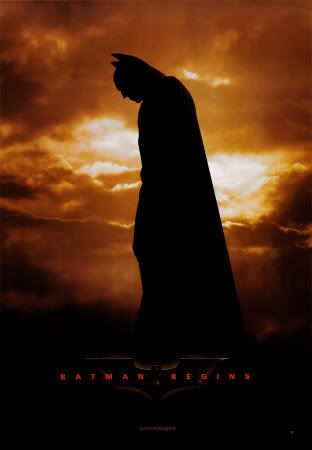 second was Christopher Nolan’s Batman Begins, in an even smaller auditorium than Disturbia. (I’d come to find out that while several of the Riviera’s theaters are quite sizable, boasting the highest overall seat-to-screen ratio in town, the ones along the western wall are as small as a cozy 109 seats.) i’d been impressed with the film when I first saw it, and though the novelty of Batman-taken-seriously dulls somewhat upon a repeat viewing, it’s still probably the superhero genre’s most successful work where psychological, emotional and procedural realism are concerned. Nolan shakes every last detail out of how a troubled billionaire playboy might go about turning himself into a creature of fear and justice, and sews them back into a creatively structured origin story that skimps on neither the pathos nor the horror that a good Batman film deserves. sure, they didn’t quite nail the cowl, and Katie Holmes fearlessly proves her own uselessness amid an otherwise perfect cast, but Batman Begins still rewrote the book on how to treat an icon to a worthy character study.
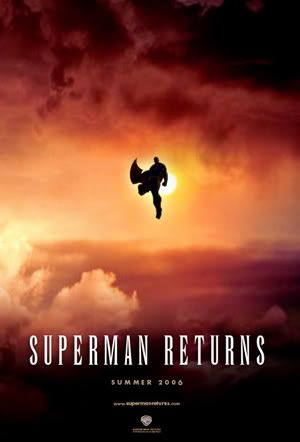 Superman Returns, on the other hand, suffers much worse upon a second viewing, and following a screening of Batman doesn’t help. approaching the other half of the World’s Finest with a realist bent surely wouldn’t have done the material any favors, but neither does Bryan Singer’s choice to wallow sloppily in Superman’s assumed iconic glow, leaning far too heavily on the continuity of Richards Donner & Lester’s first two Superman films and all but forgetting to shape the rest of the film’s lazy emotional meandering into a compelling story. Kevin Spacey strikes a smart, faithful tone as archvillain Lex Luthor, but Singer sadly refuses to follow his lead, relegating him to a dramatically inert plot while dedicating all of his energy to making everyone else flat and uninteresting, except for Lois Lane, who is well-developed insomuch as she’s quite deeply callow and unsympathetic.
WEDNESDAY – Advice From Disinterested Screenwriters On Being A Father
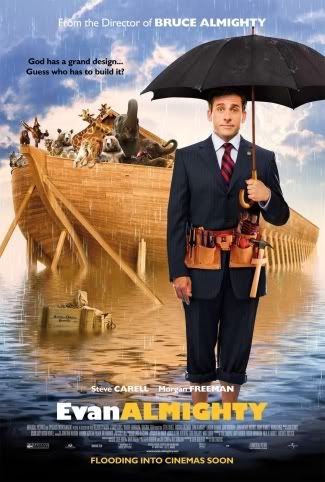 after battling a much direr parking situation at the State Street garage, I arrived at the Riviera just in time for the opening credits of Tom Shadyac’s Evan Almighty, shown in a surprisingly large auditorium befitting the film’s epic commercial and creative failure. the facile $200 million religious pander-fest revisits Bruce Almighty’s Evan Baxter (a bored, paid Steve Carrell) as God badgers him into building an ark in hopes of strengthening the bond with his three anonymous sons, with the downplayed side effect of saving two of every animal from a watery holocaust centered in suburban DC. sure, acknowledging the implied genocide of its central conceit would be kind of a comedy killer, but, then, so is the script, which is so bad that multiple scenes between Wanda Sykes, Steve Carrell, John Michael Higgins and Jonah Hill rarely even manage a laugh. Evan Almighty will no doubt find a second life as last-minute entertainment at junior high youth group lock-ins, but as a comedy (let alone the most expensive one ever made) it’s pretty worthless.
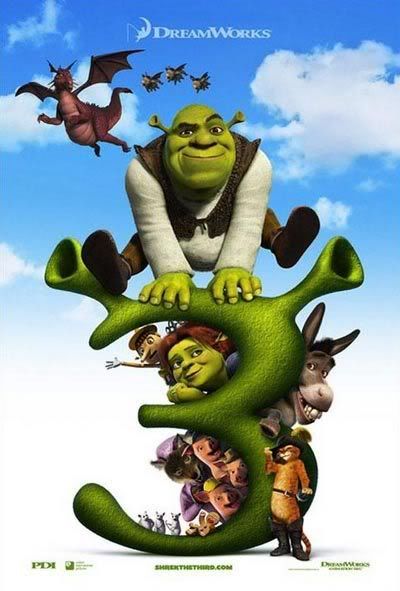 wednesday’s theme was “Christmas In August”, but none of the choices appealed to me save for Elf, which I’m content to wait until Christmas to watch again. (wednesday wishlist: A Christmas Story, Home Alone, and Die Hard.) instead, I moved on to the third installment of a franchise for which I harbor an intense distaste, but have somehow managed to see all three of; crass and unambitious, Shrek The Third is little different than its precursors, bouncing back and forth between unfunny children’s humor and unfunny adult humor in an insulting half-simulation of archrival Pixar’s warm and witty, genuinely family-friendly aesthetic. thankfully, unexplained technical issues repeatedly halted the get-em-while-they’re-young standards-lowering, and I must say that listening to the little oracle behind me rain spoilers of minor physical humor down on her sister was just as compelling, and twice as funny, as seeing it play out onscreen.
 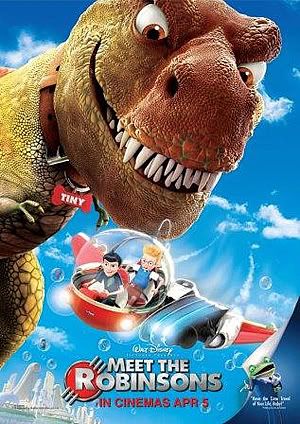 Disney’s Meet The Robinsons, however, proved a maniacally weird antidote to Shrek, despite a ten-minute wait for them to start up the projector. i regret missing it in 3-D earlier this year, but even in two dimensions it impresses, thanks primarily to its swift spirit and madcap good-naturedness, and even though it sags in places it brings a sort of restless originality to Disney’s diminishing animated efforts.
THURSDAY – Hud
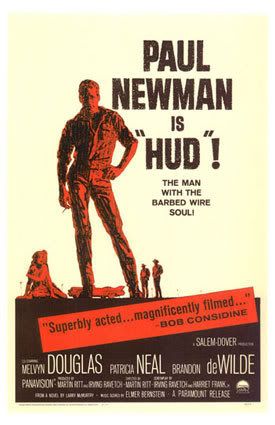 i was only able to see one film on Thursday, but it was the one I would have otherwise gone out of my way to see. Martin Ritt’s modern western Hud was presented alongside Steel Magnolias and Walk The Line under the guise of “WIVK Day On Theatre Row”, showcasing films with local ties (wishlist: James Agee’s Night Of The Hunter and Charade, the first film shown when the New Riviera was reopened in 1963), and was undoubtedly the prize of the Riviera’s pre-opening event. starring Paul Newman and Knoxville native Patricia Neal, the film takes a hard look at a family of latter-day cowboys, paying special attention to the way teenaged orphan Lonnie (Brandon DeWilde) tries to reconcile his respect for his grandfather (Melvyn Douglas) and his fascination with his callous, cavalier uncle Hud (Newman). like the other six films (which don’t even include Knocked Up, which I’d already seen twice), Hud draws heavily on themes of fatherhood, but doesn’t succumb to any of the sentimentality; no, Lonnie never seems preoccupied with his father, but studies the two men in his life carefully, finding out just for himself just who he wants to be.
Hud sees itself to a dour, cynical ending, the likes of which only come up these days in finicky indie flicks. (it’s a testament to Ritt and his film that Hud is nonetheless considered a classic.) but as the lights went up at the end and the projectionists no doubt prepared to replace the black and white dinosaur with a print of Balls Of Fury, there was a definite feeling among the audience (the largest I’d been a part of in three days) that we’d all shared a satisfying experience, taking in great cinema with the wonder they surely felt in that very spot eighty years earlier, before movies were just marketing, before everything was so crass.
(from the KNOXVILLE VOICE)
Friday, August 24, 2007
david lynch's INLAND EMPIRE (2006)
 ok, david, i give up. what's it mean?
you mean you don't know either?
oh, you don't care?
sorry, must have misheard you.
nicholas ray's REBEL WITHOUT A CAUSE (1955)
 i was alarmed and heartbroken to find that, after years of putting it off until i could see it on the big screen (mostly because it's a usual suspect for revival) that the tragic second act of Rebel Without A Cause had been ruthlessly spoiled for me years and years ago by Paula Abdul's "Rush, Rush" video. that aside, though, the film is still remarkably fresh for its age, and deep; the name (borrowed from a psychology book because...well, because it's a great name for an iconic movie) is colossally inaccurate, as every mote of rebellion (or, rather, angst) is poignantly delineated as a horrible, ineffable gift from parent to child, as Jim, Judy and Plato struggle to find the path to adulthood when the adults around them withhold influence, love, even presence. ("How can a guy grow up in a circus like that?" "Beats me, Jim. But they do.") James Dean is a revelation; i must admit this is the only one of his few films i've seen, but it's immediately clear why he still haunts American iconography. he was a beauty with a beautiful gift.
Sunday, August 19, 2007
judd apatow's THE FORTY-YEAR OLD VIRGIN (2005)
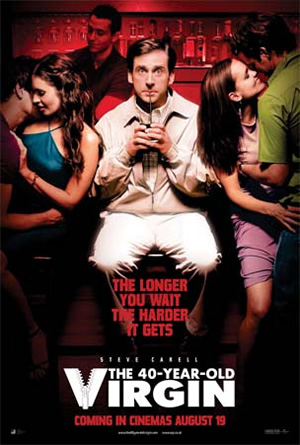 i've jocked Apatow enough lately, so i'll skip that, except to say that i'd forgotten how broad 40-Year Old Virgin is in a lot of ways, and much to its credit; sure, you have stuff like the chest-waxing and the face-vomiting, but the extent the film goes to the trouble to earn, and own, those sorts of gags is really a wonder. but the main thing, on watching the extended cut of the film: alternate cuts are usually something i regard with mild curiosity rather than excitement, but i remember being struck by the longer versions of Peter Jackson's Lord Of The Rings films (which i naturally adore) and how interesting it was to think about where and why he managed to cut so much material that, in its restored context, seems so essential. just as interesting craft-wise, though, the opposite is true of a film like The 40-Year Old Virgin, where the extended cut simply sloppies up the movie by 30%. that's not to say that extended versions of some of the funniest scenes in recent comedy aren't a joy to have access to, but comparing this newer version to the one that so impressed me in the theater is a useful highlight of what's required of a good comedic film versus a compilation, however hilarious, of funny riffs on scenes that sadly don't have any business being longer. (that's not to say 40 Year Old Virgin isn't funnier in it's longer form...it's just not necessarily as good.) again, though, a good lesson in editing: just because Apatow's films feel loose (maybe, despite the results, even a tad bit more than is good for them) doesn't mean they haven't been carefully polished. but, then, it must be that much easier now that, with DVD and all, he's only parting with the footage for four months.
Saturday, August 18, 2007
greg mottola's SUPERBAD (2007)
 it’s interesting that audiences generally demand very little from teen comedies where authenticity is concerned. while most of us haven’t ever been chased by a knife wielding maniac or (sadly) gotten caught up in a too-cute, happily ending romantic comedy, nearly everyone experienced the four years of social and hormonal torture that is high school, with the apparent exception of the people hired to write movies about it. Superbad, though, proves itself a bawdy, gorgeous exception to the rule, tackling the frustrations of late adolescence with an unexpected genuineness and an underlying emotional intelligence (quickly becoming producer Judd Apatow’s trademark) that twists its protagonists’ constant vulgarity into a sweet love song to male friendship. it certainly helps, of course, that Michael Cera and Jonah Hill turn in revelatory comedic performances as two friends in pursuit of booze, though their chemistry does become a sort of liability for the film as it progresses, due simply to the fact that a typically less-funny subplot concerning a third friend’s misadventures with a pair of wistful cops persists in drawing us away from Cera and Hill, and slows the movie down in the process. still, Superbad is a distinct treat, destined for cult status and content for the moment with being the funniest movie of the summer.
matthew vaughan's STARDUST (2007)
 Vaughan's winning, clumsy comic fantasy has been subjected to more than a few Princess Bride comparisons, but it's the two films' key dissimilarity that's most interesting: Princess Bride allows its fantastical adventure to flourish in the background of its wit and whimsy, while Stardust unwisely puts these elements at odds with each other, trading in tonal focus for a strained grandiosity (one hopes Vaughan was at least offered a bulk discount on sweeping aerial shots) that leaves it on an awkward fence between the genres. it's a pity, too, because Stardust is an otherwise charming piece of late-summer escapism, stocked with a game cast and a refreshingly fun, ribald attitude that raises it well above any of its peers in the post-Frodo/Aslan cash-in frenzy, even if one is left with the distinct impression that Neil Gaiman's source novel is probably that much more entertaining.
werner herzog's RESCUE DAWN (2007)
 one of the most immediately apparent qualities of Herzog's Vietnam-era POW drama is a relative technical crudity, particularly compared with the stylistically slick (albeit usually "gritty") war films we're accustomed to; it's pieced together without much regard for useful conventions of story and pacing, and only occasionally takes the time to drink in the imposing splendor of the Laotian jungles that so thanklessly serve as its backdrop. but this indifference to expectations is symptomatic of what ends up being the film's greatest strength: downed American pilot Deiter Dengler's harrowing journey into and out of a makeshift prisoner camp is lent an astonishing dimension of truth (as it deserves, being a true story) by Herzog's dismissive attitude towards affected Hollywood scriptcraft. Dengler's fiancée, for instance, is mentioned in a brief anecdote, but we aren't subjected to mooshy bookends; Dengler recounts his childhood inspiration to be an aviator, but we aren't whisked away to flashback; Dengler is betrayed, and the betrayer walks away from the narrative's grasp, or concern. instead, there are only scenes, however disjointed, from the barefooted jungle travails of a mild man unwavering in his intent to emerge a survivor, and even if Herzog never hits at the heart of Dengler's character, his journey is uniquely credible enough to make us reflect on our own.

Monday, August 06, 2007
david lean's LAWRENCE OF ARABIA (1962)
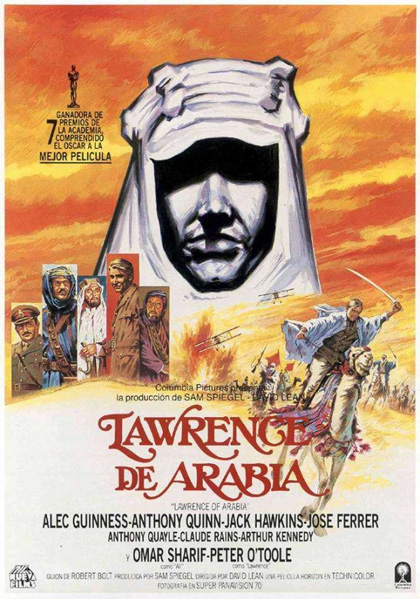 having never seen it before this weekend's presentation at the Tennessee Theatre (i had been holding out for the big screen), Lawrence Of Arabia was an interesting surprise to me. i'd expected an epic, and an epic it certainly is, the sort that Hollywood has forgotten how to make - it's not just the size of the canvas but also the level of detail you place on it, and Lawrence draws fine, patient lines where today's outsize spectacles throw broad, lazy strokes. yet it's not these lines that really matter in the film, but what's between them: a careful (though occasionally oblique, and frustrating) character study well-merited by a figure of such mystique. it would have been enough for the film to wrestle with itself over whether T.E. Lawrence (played with a distinct otherworldliness by Peter O'Toole) is a noble warrior or a patronizing, narcissistic creature of dangerous folly, but Lean and screenwriter Robert Bolt smartly pester the audience with a further question only they can answer: does it matter that he's both?
Saturday, August 04, 2007
paul greengrass' THE BOURNE ULTIMATUM (2007)
 Greengrass is at this point responsible for two of the decade’s finest, most affecting films in Bloody Sunday and United 93, so it seems a little strange that he’s also behind a pair of its most breathless, rollicking action flicks, but it’s the gravity and apparent lack of polish that make The Bourne Supremacy and The Bourne Identity such essential, encouraging mainstream fare. in Ultimatum an impeccably beefy Matt Damon (nearly unrecognizable next to the bucktoothed smile in a few carefully recycled flashbacks) continues his reign of terror upon the people who so tragically made him into such a badass, and Greengrass once again drags the audience by the gut through a minefield of dense conspiracy and virtually nonstop action setpieces, his camera shimmying and shaking all the while in a verité whirlwind of combat best observed during a hand-to-hand fight to the death during which neither the musical score nor the audience dare make a sound. earlier this summer Live Free Or Die Hard scored points by looking amiably back at the whiz-bang of 90s action, but it’s nice to know that the Bourne films continue to grow in popularity by keeping their eyes fixed firmly forward.
Friday, August 03, 2007
billy wilder's ACE IN THE HOLE (1951)

not long before the end of "Portrait Of A 60% Perfect Man", the centerpiece special feature on Criterion's spectacular new DVD release of Billy Wilder's Ace In The Hole, film critic Michel Ciment is unfortunate enough to voice an observation about the warming romanticism of Wilder's later work, at least in comparison with the good-natured acerbicism of his best-known films. the 74-year old Wilder, ambling around the patio of his California home, immediately perks up in his own defense. "Don't say that," he fumes playfully. "I want to be known as a cynic, as somebody with a vitriolic tongue, I like that much better. I don't want to be known as a softie." Wilder is obviously amused, but there's little to suggest that he's not perfectly serious.
among Hollywood's all-time greats, Billy Wilder has the filmography to back up his claims to such cynicism, however sweet. responsible for films like Some Like It Hot, Sunset Boulevard, Double Indemnity, and The Apartment (to name only the most classic of the classic), the writer-director always sought to push the envelope as he entertained, and took obvious pleasure from highlighting the unsavory corners of the mundane. and it's this aspect of Wilder's creative personality that makes Ace In The Hole, released in 1951 but previously unavailable on home video, such an essential piece: this is Wilder at his most forceful, uncharacteristically disinterested in anything but illuminating society's basest tendencies. it starts mean and it ends sad, and 56 years later it strikes a deeper chord than ever.
the film follows disgraced big-city reporter Chuck Tatum (a fiery Kirk Douglas) as he joins the staff of an Albuquerque daily in an effort to work his way back up the ladder. such an opportunity eventually reveals itself at a pit stop on the way to cover a rattlesnake hunt, where Tatum and his young photographer learn that the filling station's proprietor, in search of Indian relics, has been trapped in an underground shaft. Tatum sees his in and seizes it, deftly tipping the national spotlight to a roadside cliff dwelling and the tasty "human interest story" trapped within, and before long the local sheriff, an excavation contractor, and even the man's own wife are on board to milk power, money, and fame out of the would-be tragedy...even if it means protracting his rescue.
Ace In The Hole was an abject failure upon its release, both commercially and critically, and it's not hard to see why: it's a nasty, bleak portrait of America at its worst, and offputtingly bereft of the witty humor that marks nearly all of Wilder's other work. but it's also fearless in its misanthropy, and uncomfortably prescient, as our news media has done little but slouch toward Tatum's ethically desolate sensationalism in the ensuing years. it’s the subtext to Wilder's ruthless indictment of the burgeoning Media Circus phenomenon, though, that contains Ace In The Hole’s most scathing, and important, lesson: the blame lays as much with the consumer as the producer.
true to form, the Criterion Collection has bestowed Ace In The Hole with an impressive restoration and a collection of supplementary material befitting an American master’s lost opus, from a fine commentary to a handful of lengthy interview pieces, including the aforementioned hour-long 1980 bull session with Ciment. (there’s even a video afterword by Spike Lee, speaking of how the film’s social outrage influenced his own work and proudly showing off a poster signed by Wilder and Douglas.) given both the film’s bottomless relevance and own compelling history (before being essentially buried for half a century, for instance, it was briefly re-released with the “more cheerful” title The Big Carnival), it’s a bit of a shame that the producers of the two-disc set weren’t able to present a bit more about the film itself, but the focus on Wilder is a welcome tribute. and though it’d be unfair to say that Ace In The Hole is one of his very best films, its merits extend beyond its notoriety, and its teeth are as sharp as anything Hollywood has dared to make since.
(from the KNOXVILLE VOICE)
Subscribe to:
Posts (Atom)

 Posts
Posts


