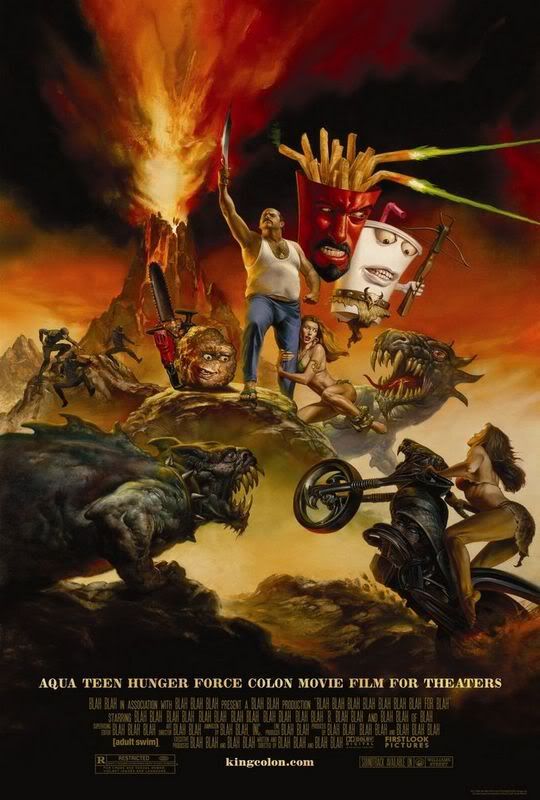
 though it can be self-indulgent and overly juvenile, ATHF is honestly a pretty brilliant show, standing on the shoulders of Space Ghost Coast To Coast's sublime, revolutionary absurdity and somehow taking it a step further in both popularity and sheer strangeness, if not quality. but it can also be exhausting, and even in fifteen-minute installments it constantly verges on narrative implosion, so it was a pleasant enough surprise that Colon Movie Film For Theaters afforded itself a fair bit of breathing room without losing too much of its verve. as with the Reno 911 movie, it would have been interesting for the show to step out of its comfort zone a little, but there's also something to be said for sticking with what works, and for an epic, stoned non sequitur it works pretty well at feature length.
Thursday, April 26, 2007
williams street's AQUA TEEN HUNGER FORCE COLON MOVIE FILM FOR THEATERS (2007)
though it can be self-indulgent and overly juvenile, ATHF is honestly a pretty brilliant show, standing on the shoulders of Space Ghost Coast To Coast's sublime, revolutionary absurdity and somehow taking it a step further in both popularity and sheer strangeness, if not quality. but it can also be exhausting, and even in fifteen-minute installments it constantly verges on narrative implosion, so it was a pleasant enough surprise that Colon Movie Film For Theaters afforded itself a fair bit of breathing room without losing too much of its verve. as with the Reno 911 movie, it would have been interesting for the show to step out of its comfort zone a little, but there's also something to be said for sticking with what works, and for an epic, stoned non sequitur it works pretty well at feature length.
Tuesday, April 24, 2007
lucio fulci's CITY OF THE DEAD (1980)
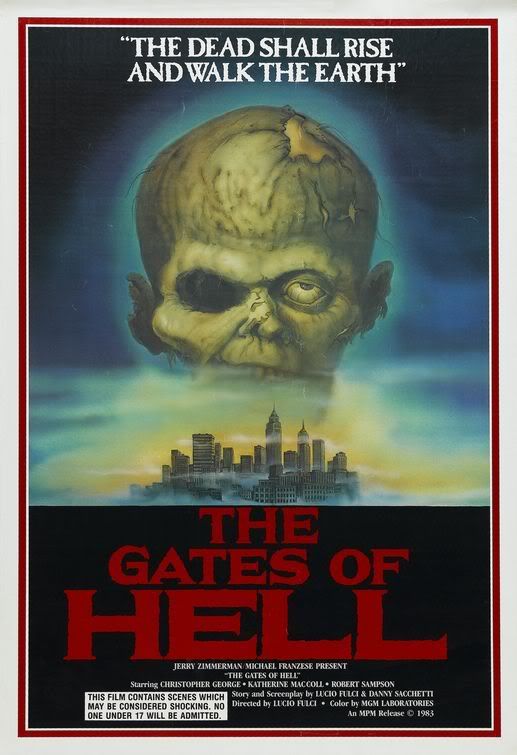 i'm a little out of my element here with italian zombie scuzz, but i can say that Fulci's ability to wrench mood and atmosphere from poor performances and sub-modest production values really impresses. (if my limited recollection of Zombi serves me, that seems to be his typical aesthetic, but it still suggests a vision strong enough to overcome such shortcomings.) the music is great (until the end at least) and the gore is positively stomach-turning, especially in the notorious gut-vomit scene. but it all sputters to a slow stop during the (anti-)climax, and then nails the coffin shut with an unintelligible, unintentionally silly ending. sad that something with such ideas, such promise, could be so flawed.
Saturday, April 21, 2007
edgar wright's HOT FUZZ (2007)
 parody has always been satire’s ne’er-do-well stepbrother, but the cinema of recent years has been particularly unkind to it, with Scary Movie and its ilk actively devolving the genre into strings of crass jokes and shallow pop culture references swept from the floor of an unfruitful Cracked Magazine writer’s meeting. so exhilarating, then, that Hot Fuzz sees Edgar Wright and Simon Pegg deliver on the promise of their “zom-rom-com” Shaun Of The Dead, thoughtfully turning their eye to contemporary action film with affection, respect, and no small amount of wit. it’s Wright’s grip on the grammar of the Big-Ass Action Flick that really sells it; Hot Fuzz’s quiet first act, for instance, is occasionally punctuated by rapid, showy montage that, recontextualized into the mundane, highlights an inherent obnoxiousness, while the film’s action-packed climax cribs directly (and effectively) from the Michael Bay / Tony Scott playbook with playful awe.
as impressive as the artifice is, though, the film obviously couldn’t rely on stylistic quotation alone. thankfully Fuzz’s script is full of both the low-key, character-driven comedy and clever command of genre that made Shaun Of The Dead such a joy, and the way the three elements work together reveals a lot about the nature of accomplished parody. the film has its own story to tell, and weaves genre convention (subverted, exalted, or both) together with genuine comedy where lesser efforts would simply rely on one to prop up the other. the result, then, is maybe less a parody than a riotously funny, only slightly backhanded homage.

Tuesday, April 17, 2007
alfred hitchcock's NORTH BY NORTHWEST (1959)
 The most interesting thing about North By Northwest as compared to Hitchcock’s other best-regarded thrillers is that it’s flippant, even silly; you can almost hear Hitch chuckling in the background of every scene. Part of this is naturally due to Cary Grant’s signature gentle self-parody, but both Hitchcock and screenwriter Ernest Lehman are perfectly willing accomplices, allowing/encouraging Grant to defuse their expert suspense scenarios with outrageous aplomb. Megadosed with bourbon and put behind the wheel of a car, for instance, Grant’s Thornhill opts not to brake, but rather visibly settles in for a nice drunken drive, while later in the film an understated auction scene, rife with tension, is gleefully torpedoed (and cleverly resolved) with absurd outbursts and sucker punches. But despite Grant’s general goofiness and Eva Marie Saint’s censor-needling innuendoes, it’s Hitchcock that drolly steals show, thanks to the middle-of-nowhere duel between Grant and a rogue crop-duster; this implausible, leftfield plot detour has its company among his most iconic sequences, but as a synthesis of his stylistic virtuosity and formidable wit, it’s practically peerless. overall NxNW is a touch sloppier than his other major works, mostly due to the consistent stutter of its pacing (climaxing in a final narrative hiccup that never fails to disappoint) and an admitted overabundance of levity, but there's highlight reel moments a-plenty, and for what it's worth it's one of his broadest entertainments.
Saturday, April 07, 2007
rodriguez & tarantino's GRINDHOUSE (2007)
 it's difficult to approach Grindhouse from a critical point of view, at least so soon after a first viewing, because it still exists in my mind as an experience rather than a work of art. the film's publicity has made a whole lot of noise about Tarantino and Rodriguez's yearning affection for the bygone days of schlocksploitation double features, but in practice Grindhouse reaches more universal heights, even for those who know the film's reference points only by vague reputation: it reminds us how ridiculously fucking fun it can be to go out and see a movie. as the audience laughed, cheered, hooted, hollered, clapped and cursed in harmony with each other, there was a glow of shared experience that's all but foreign in latter-day cineplexes, and for the first time in a long time i felt like i'd really gotten my eight bucks' worth.
Rodriguez's segment seems the more successful of the two films, at least insofar as the project's thesis goes: Planet Terror grabs the bronco of grindhouse cinema by its horns and balls and manages to hang on for most of its running time, primarily thanks to a wealth of wit, energy and ideas that somehow keeps the novelty of the whole spectacle from wearing off. (oddly, when it does sadly and inevitably lose its momentum, the most direct culprit is Tarantino, in a terrible cameo role that could almost be interpreted as sabotage.) the final sequences remain interesting, though, and despite their mania amount to a sort of break for the audience, who upon its conclusion are immediately assaulted with a series of breathlessly brilliant Coming Attractions mockups by Rob Zombie, Edgar Wright and Eli Roth. (Roth's in particular is hilariously, uncomfortably spot-on in its evocation of the no-budget slash trash for which i harbor an extreme phobia.)
Tarantino's segment, however, proves to be a different animal. where Planet Terror is Robert Rodriguez's love letter to the films from which Grindhouse takes its inspiration, Death Proof is, as usual, Quentin Tarantino's love letter to Quentin Tarantino; the first of the film's two acts is fatally, self-indulgently bloated with his trademark Witty Banter, and for the second time over the course of Grindhouse's three-plus hour running time, Quentin Tarantino is responsible for bringing everything to a screeching halt. but we've all learned two things about Tarantino over the course of his career: 1) he's an insufferable douchebag and 2) it doesn't matter, because he's a genuinely brilliant filmmaker. accordingly, a sudden, shocking climax throws the unsettled audience into an unexpected second act that initially echoes the first act's inactivity but quickly begins to take its own shape, culminating in an extended action sequence as visceral and expert as anything in Tarantino's oeuvre. Death Proof's payoff not only retroactively transforms the first act's unconcerned pacing into a ballsy model of unconventional exposition, but also more impressively elevates the film as a whole into an amalgamated homage to exploitation cinema that reduces Planet Terror to mere mimicry by comparison.
overall, though, the expertly sequenced double feature format does both films favors that probably prove key to their individual successes, and the pacing and energy of Grindhouse as a whole makes it more than the sum of its parts. it's by some measure the most fun i can remember ever having at the movies, and i look forward to seeing it again.
Tuesday, April 03, 2007
robert altman's CALIFORNIA SPLIT (1974)
 even shoulder to shoulder with the rest of Altman's filmography, California Split is astonishingly naturalistic; plot is generally of little use to it, and it offers instead a character study of the Gambler, as portrayed by George Seagal and Elliot Gould as two sides of the same coin, banding together in an effort to appease their sickness. Gould is magnetic as always, and the more compelling of the two, as the thrill of the wager seems to have become a Great Truth in the manner he lives his life, and in collaboration with Seagal he becomes the ultimate enabler. but their connection, however ugly in its realities, yields a certain passion between the two men, and so Split is also a softly touching examination of an adoring (but nonetheless star-crossed) platonic relationship.
Monday, April 02, 2007
robert bresson's DIARY OF A COUNTRY PRIEST (1951)
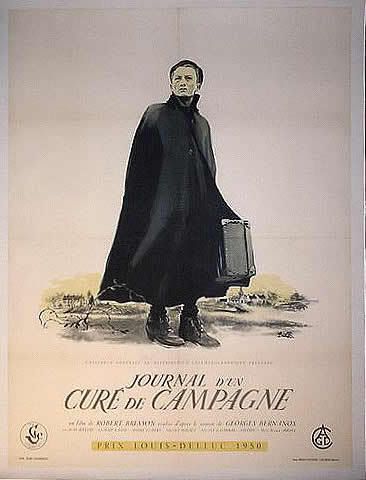 the thing that's most striking to me about Robert Bresson is that his craft is so internal - unschooled performances and an almost indifferent visual approach come together in his hands as distilled, otherworldly melodrama in touch with the human (or donkey) condition, so bleak and beautiful, while the mechanics remain obscured. sad that Country Priest was showing (at nashville's belcourt) a week too early for easter; it seems like it would be a pretty powerful way for adventurous christians to spend their holiest day. but it's sad, and it doesn't offer any easy answers. has god has abandoned the ambricourt parish? possibly. (it doesn't offer so much as an easy question.) but the priest is god's device of grace, and hope clings to the sorry creatures that surround him. the climax of the second act, wherein he rebuilds a grieving mother's faith by tearing her down, is drunk on equal parts Holy Spirit and stony fatalism, and is surely among the screen's most harrowing, insightful ruminations on the politics of faith. but the rest of the film is a minor key played softly, just as with Bresson's other work. his filmmaking doesn't insist upon itself, even as it clutches your lapel and leads a sad dance.
Tuesday, March 27, 2007
francis ford coppola's BRAM STOKER'S DRACULA (1992)
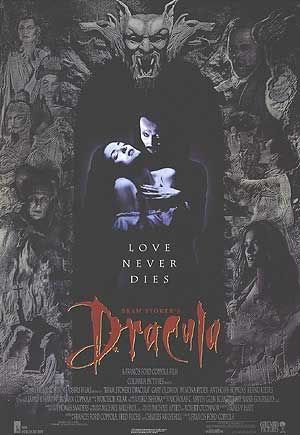 (or most of it, at least.)
it's so curious to me that someone like Coppola, surely a master right out of the gate in the early 70s, could be guilty of the poor filmmaking taste on display here. his intentions for the picture are obvious (expressionism, lush design and color, gothic romanticism) but recklessly undone at every turn by distressingly uneven production values (DP Michael Ballhaus seems to bathe every third shot in ugly, inappropriate natural light) and a distinct disinterest in cultivating a tone (any tone!) capable of keeping the story afloat. the movie simply ping-pongs back and forth between austerity and camp, using neither to its advantage. and while Gary Oldman and Tom Waits are able to manage James Hart's fatally unimaginative script, the rest of the cast struggles, particularly Keanu Reeves, who in all fairness would probably struggle on Days Of Our Lives. Dracula feels like an uninspired first draft of what it seems like a Coppola vampire movie ought to be.
"the horror...the [inept, simulated] horror..."
Friday, March 23, 2007
alfred hitchcock's TORN CURTAIN (1966)

it's a shame that the modern thriller has so largely abandoned the pioneering Alfred Hitchcock did in its name throughout his career. even a minor Hitchcock like the brainy cold war thriller Torn Curtain (ranked as his 39th best film by IMDb!) presents at least three or four direct testaments to his preternatural skill for lacing scenes with suffocating suspense, no matter the surroundings. footsteps in a museum, an ersatz bus route, even a chalkboard equation showdown between two scientific minds - Hitchcock transforms each of them into scenarios as unbearably tense as they are goddamned entertaining. he doesn't cheat, or cut corners...we are always assured that he's in total control, using every situation to his advantage. the film is not perfect, of course; the logic and motivations, particularly as they pertain to espionage, are a little shaky, and a poignant but unnecessary encounter with a strange Polish woman stops the otherwise action-packed third act dead in its tracks. but there's still so much to learn, and so much to enjoy! even Hitchcock's non-canonical work looms over the genre his absence ruined.
woody allen's TAKE THE MONEY AND RUN (1969)
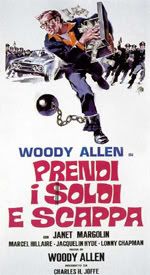 this is Woody's first film, and it shows; while all of his directorial work through 1975's Love And Death can be reasonably described as little more than jokes strung together on film, Take The Money And Run is by some measure the most rudimentary in its approach. not that there's anything wrong with it, of course! the mockumentary frame is an able vessel for the disjointed setup-punchline-proceed approach, and it's interesting to observe some of his sensibilities (at least pertaining to said early work) emerging fully-formed while others develop as we watch. as debuts go, it's great, particularly the full-speed-ahead pre-title sequence.
joon-ho bong's THE HOST (2006)
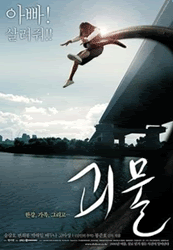 Where have all the monsters gone? In recent years horror film has enjoyed the same sort of resurgence it seems to experience every decade, but world events in the meantime seem to have altered its cultural purpose. Where the 1980s gave us the popcorn franchise frights like the Friday The 13th films and the mid-nineties saw Scream beget a string of deceptively tongue-in-cheek (though largely unfortunate) teen slasher flicks, the most current crop has little use for irony or escapism, instead relying largely on moral desolation and crass brutality, as if we pay eight dollars on a Friday night to confront our heightened anxieties rather than forget them. Sadly, this emphasis on monstrousness has also left little room for the sort of monsters that defined the genre, monsters who now find superior purchase in fantasy (King Kong) and even the family film (Wallace & Gromit: The Curse Of The Were-Rabbit.)
This decided shift in horror cinema’s fabric only strengthens the achievement of Bong Joon-ho’s playful, unpredictable The Host, a Monster Movie in the most grand, classic sense. The highest-grossing film in the history of its native South Korea, The Host opens (after a short prelude) on a sunny Seoul afternoon as snack bar operator and single father Park Gang-du (Song Kang-ho) witnesses an enormous reptilian fish creature emerge from the Han River and rampage through a riverside park, taking his daughter Hyun-Seo with it as it finally resubmerges. As public panic ensues, exacerbated by the government’s revelation that the creature is host to a deadly virus, Gang-du and his family are forced to flee the quarantine in order to find Hyun-Seo.
That we see the monster in broad daylight for an extended sequence within the first few minutes of the film not only signals Bong’s rightful confidence in his distinctive, creative creature effects (handled impressively by the California-based Orphanage), but also a promise that the rest of The Host is happy to deliver upon: the rules are made to be broken. The horror film (and by extension the monster movie) has historically been a breeding ground for cliché, but the Park family’s saga seems to openly refuse and defy the genre’s baser conventions, from the organic, internally logical plot to the warm, emotional tone of the character work. The suspense and scares, too, are genuine; where many films have slouched into the routine of “loud sound / cue bad guy”, Bong steadfastly refuses to cheat his audience. Most importantly, the film’s emphasis on familial love and loyalty unsurprisingly lends the inevitable deaths a consuming gravity, a trait sorely missing from The Host’s hollow, crass horror contemporaries.
What makes the film most notable, though, is that it seems to single-handedly spit the monster movie squarely into the 21st century. These stories have always been reflections of deeper fears, from Shelley’s science-panicked Frankenstein to the poignant post-nuke anxieties that inform Japanese creations like Godzilla; here, too, Bong addresses his culture’s concerns, particularly as they relate to biological dangers. In the face of a horrific creature haunting the waters of the Han, the government seems more immediately concerned with the virus it apparently carries, and dedicates their resources toward a strict quarantine while Gang-du and his family are left to deal with the beast by themselves. This uncareful alarmism, coupled with the unmistakable iconography of the SARS and Avian Flu outbreaks, gives the film’s underlying unease a solid base in recent cultural psychology.
The Host is also amusingly contemporary in its portrayal of its few American characters. Our government and military play a key role as the story progresses, and Bong’s script (with Baek Chul-hyun) approaches our own cultural idiosyncrasies with a keen satirical eye that never steps out of line into demonization, just as he ribs his own South Korean government. The whole script, in fact, is filled with an endearing, witty goofiness, sharp yet warmhearted. Several reviews have made lofty comparisons to Jaws and Jurassic Park, and the similarity extends beyond their respective places in the monster movie canon; much of The Host draws carefully but cheerfully on Spielbergian populism.
As The Host rolls out its American release to reportedly enthusiastic audiences (the first showing at Nashville’s Belcourt sold out days in advance), it’s enticing to think about the return of the monster movie, or even a shift in horror’s stagnant course. But to hope for such things is to downplay The Host’s tremendous uniqueness: funny, smart, original, beautiful, and scary, it’s an unusual creature in its own right.
(from the KNOXVILLE VOICE)
Saturday, March 17, 2007
craig brewer's BLACK SNAKE MOAN (2007)
 Sam Jackson has fallen prey to an unfortunate curse over the past few years: his reputation as a reliable, inimitable performer has led to a string of lazily conceived and written roles that rely on him to do all of the heavy lifting. nevermind that, given the right material, he's one of our great actors - just throw a little extra profanity in the script and start shooting. whether it's Snakes On A Plane, XXX, or even a Star Wars prequel, we aren't thinking about Sam Jackson's character. we're just thinking about Sam Jackson.
thankfully, Craig Brewer's vibrant, dusty Black Snake Moan temporarily lifts the curse, giving Jackson a role that caters to his strengths as an actor rather than a Badass. though the provocative ad campaign suggests pulpy exploitation, the film is really a story of sin, fatherhood, and the blues, with Jackson at the center as Lazarus, a jilted Southern farmer who decides to take in a battered local harlot and cure her of her "wickedness." not that Lazarus is a prude, or a zealot; in fact, much of the film's beauty stems from his complicated, obscured motivations. his Christianity runs deep but stays deep, and he pines for his two-timing wife and the child she never let into the world. most of all, though, he exhibits a deep understanding of sin - not as an arbitrary religious concept, but as one of the forces that turns the world.
for all of these reasons and more, Lazarus decides to chain Rae (a waifish Christina Ricci) to his radiator in order to save her from her own demons, which she has neither the wisdom nor the inclination to bottle. this central plot point is, of course, loaded both racially and sexually, but the script treads surprisingly lightly while never chickening out. there is a grimy sensuality to much of the film (mostly due to Ricci's half-clad fearlessness), but it is very rarely sexy; Brewer stays true to his themes by steering clear of titillation where lesser talents would have their cake and screw it too. indeed, the strange, tense chemistry between the Rare and Lazarus eventually (and organically) defuses into a warmly rendered father/daughter dynamic on which the remainder of the film coasts to a refreshingly hopeful denouement, suggesting that even god's most flawed children are entitled to a shot at happiness.
Black Snake Moan shares two key elements with Hustle & Flow, Brewer's previous feature, that seem to define his sensibilities as a filmmaker. the first is the South, so rarely presented onscreen with a depth and regard befitting the heart and soul of true American cultural tradition. the second, and more profound, is music: Hustle & Flow tracked the struggle of a lowlife pimp who finds sadly tentative redemption in the arms of crunk rap, allowing him to redefine himself through the creative process, while Black Snake Moan concerns itself with the Blues, both as musical expression and an ineffable state of mind. the score and soundtrack bestow the film with considerable texture, but it's Lazarus' own blues that stay with the viewer - a further credit to Jackson's layered performance. that his voice doesn't necessarily fit with the bluesman ideal (aside from a sublimely menacing rendition of "Stagger Lee") seems immaterial when it emerges from Lazarus' troubled mouth, and two of the film's most exhilirating sequences respectively embody a tension and release that burrows to the heart of the narrative. in one, Rae clings tightly to Lazarus' leg as he drowns out a thunderstorm with the harrowing title track; in the other, Lazarus returns triumphantly to the juke joint he once haunted and plays to an audience ecstatic in the proposition of transforming his sorrows into the joy of shared expression. the music makes clear what the film sometimes fails to: in the absence of true happiness, we can find relief in art and expression, and the best blues are blues shared.
Friday, March 16, 2007
woody allen's SCOOP (2006)
 after the unqualified artistic success of Match Point, which caught even the most apologist of his fans off guard, Scoop unfortunately finds Woody trying once again to simply keep his head above water. to its credit, it's pleasant (after the dreadful, grating Anything Else, that in itself is a godsend) and Allen seems more comfortable here than in Curse Of The Jade Scorpion using whodunit conventions as a frame for comedy. but as with most of his later, lesser work, much of the humor is conspicuously laborious, and does no favors for muse-du-jour Scarlett Johansson, whose tenuous but endearingly awkward read on her character is repeatedly torpedoed by bum gags. Ian McShane shines in an unfortunately minor role as a dead reporter, and Hugh Jackman is charming as a suspected murderer of prostitutes. hell, even Woody himself seems more comfortable onscreen than he has since Small Time Crooks. but the material's just not there, and so the slide regretfully continues.
Thursday, March 15, 2007
david fincher's ZODIAC (2007)

you'd never guess watching Zodiac that David Fincher hasn't made a film in half a decade; in fact, the enormous maturity of craft on display would suggest that he's spent the interim doing nothing but. he approaches the material with a confidence almost entirely removed from the marvelous (but showy, and distancing) technicality of Fight Club and Panic Room, resulting in a powerful, eminently engaging piece of true-crime police procedural rooted in the experience of three characters, each obsessed to different degrees and ends with deciphering the puzzle of the Zodiac killer. (the grander puzzle, that is; the cyphers are little more than a red herring.) this is an obsession we've seen onscreen before, of course, but Fincher breathes new life into it, even while wrestling with a story that weaves between countless secondary characters and spans more than twenty years. even more impressive is the unlikely coup of making a nearly three-hour serial killer film with maybe five minutes of violence and no resolution into such a pleasant, absorbing work, and here the credit must be spread around from Fincher to his stellar cast and James Vanderbilt's smart screenplay, possibly most notable for it's surprising, winning humor. Zodiac respects its audience to a degree we rarely see in mainstream crime drama, and it's impossible not to return the favor. this is the best film of 2007 so far, and probably won't be topped for months.
Tuesday, March 13, 2007
zak snyder's 300 (2007)
 300 has considerably more in common with Robert Rodriguez's Sin City than just shared creator Frank Miller. both are heedless orgies of violence, both are markedly stranger than most films that achieve such popularity, and both are towering visual achievements borne of the confluence of CG filmmaking's final maturations and the box office vogue of comic book adaptations. but the best way to approach discussion of 300 isn't the similarities between the two projects, but rather their key difference: Sin City is a story, with characters, emotions, and motivations, however depraved, and the books' visual and storytelling sensibilities are rooted quite firmly in the seedy stomach of film noir, making Rodriguez's task more akin to retranslation. Miller's crude, majestic impressionist eulogy to the 300 Spartans, however, is an achievement precisely because it's unconcerned with the nuts and bolts of plot and conventional comic book storytelling, opting instead for somber spectacle.
and what spectacle emerges from Snyder's adaptation! the film is entrancing visually, even if the bulk of the compositional verve comes straight from Miller's pages. the human form and the macabre ballet of antiquity's combat are on full display in every frame, and though it's color-corrected and cg-airbrushed all to hell, the aesthetic never falters. the guitars chugga, the troublesomely Other eastern hordes charge, and we're dipped and twirled from slo-motion into slo-er-motion. the figures in movement do Miller's images enormous justice, and in this most important respect the adaptation is a complete success.
what they've adapted, though, is tragically unsuited to feature film from a narrative point of view, and offputtingly dull as a result. though certainly cinematic in nature, 300's structure and flow operate on atypical terms, and Snyder's direct reading turns a rage-blind eye to the inherent dramatic hurdles, hoping to coast by on panache alone. but lacking even cursory investment in our heroes and their impossible quest, we begin to feel that the film is progressing by simple blueprint, like a bedtime story halfheartedly read. so what's been achieved? what's the point of Snyder basically tracing 300 onto a computer screen?
the ideas that emerge amidst the bellowing and bloodshed have created a minor stir in the leadup to the film's release. in one sense, of course, any comparisons to be drawn between 21st century geopolitics and the battle of Thermopylae are history's fault alone. but the film is still a product of its own time, and 300's most potent surprise turns out to be its ringing endorsement of american warmongering. though Leonidas' hubris is as bare as his torso, it's treated more as a quirk than a vice; as the Spartans and a trifling coalition fight off warriors from an unfamiliar (and thus foul) place, the real value is placed on bravery and nationalism. and back in Sparta, an unscrupulous opponent of the ill-advised pre-emptive combat turns out to be literally working with the enemy. though these certainly aren't the type of ideas that need to be perpetuated, especially subconsciously, there's a strange courage in the film's defiance of leftist Hollywood convention. otherwise, 300 is nearly entirely an exercise in style, executed with an outrageous pomposity and visual mastery. eclipsed by a story poorly told, however, Miller's impressionism just becomes Snyder's impression.
Subscribe to:
Posts (Atom)

 Posts


