
Showing posts with label france. Show all posts
Showing posts with label france. Show all posts
Monday, November 10, 2008

Monday, August 18, 2008
jacques tati's TRAFIC (1971)
 French actor and filmmaker Jacques Tati only made a handful of films (most of them starring his bumbling, guileless alter ego Monsieur Hulot) but his inimitable blend of physical humor, quizzical social commentary and visual acuity was sufficiently brilliant to ensure that each remains in high regard despite its flaws. this pertains particularly to 1971's Trafic, the final and slightest of his Hulot quartet, but the film still handily impresses; the most plot-driven (insomuch as you can actually synopsize it) of Hulot's outings, Trafic finds him a car designer tasked with transporting his company's latest prototype to an Amsterdam car show. that Hulot is here enabling unbridled modernity is somewhat of a break for the character, but the attitude remains faithful: Hulot's position and task lay a foundation for Trafic's visual and thematic emphasis on the ubiquitousness of the automobile, which pays off repeatedly even if it doesn't leave as focused an impression as its predecessors. but the main attraction, as with all of Tati’s work, is the singular sort of cartoony comic ballet that overtakes every action and detail; as gifted as Tati is as a physical comedian, his real (and rare) contribution to comedy is his profound exploitation of the medium itself, twisted, bent, and made beautiful by the whims of one of film comedy’s genuine visionaries.
(from the KNOXVILLE VOICE)
Saturday, February 09, 2008
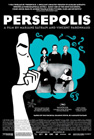
vincent paronnaud & marjane satrapi's PERSEPOLIS (2007)
 “In this life you’ll meet a lot of jerks. If they hurt you, tell yourself that it’s their own stupidity that makes them act that way. That will keep you from responding to their meanness. There’s nothing worse in this world than bitterness and revenge.”
first published in France in 2001, Marjane Satrapi’s black and white graphic autobiography Persepolis has enjoyed a significant degree of crossover success throughout the world, and for good reason: her introspective, emotionally loaded memoir represents the best facets of what we talk about when we talk about comics as art (paving the way for similarly outstanding works like Craig Thompson’s Blankets and Alison Bechdel’s Fun Home) while telling a lively, universal, and occasionally devastating tale of childhood.
what makes the book so significant, however, is its backdrop. Satrapi’s early adolescence was spent in the shadow of the Iranian Revolution, which in 1979 saw the country transition violently from monarchy to theocratic republic, and Persepolis is most valuable in its accessible survey of the complexities and contradictions of pre- and post-Revolution Iran, all seen through the eyes of a little girl to whom Islamic law and nationalistic fervor mean nothing compared to the safety and happiness of those she loves. it’s not the story of a hero, but of an observer forced to learn, endure, and eventually escape to the relative sanity of the outside world.
still, Satrapi remains reverent to her roots and her nation, and the result is illuminating for Westerners seeking insight and context into the generally alien Islamic world: we are shown, as we should be shown every day, that within these sad, prideful national constructs are millions of people with the same problems and aspirations as anyone else in the world.
now Persepolis has found its way to an even larger audience by way of Satrapi & Vincent Parranoud’s Oscar-nominated animated feature, a combined abridgement of Persepolis and its 2004 sequel. the film follows Satrapi’s tiny pen-and-ink doppelganger through these formative years, as she dreams of being the last prophet before the revolution shifts her country’s well-being from bad (the Shah) to worse (Khomeni) to worst (the bloody, protracted Iran-Iraq War.) eventually her parents decide to send her to school in Vienna, where her horizons are finally allowed full latitude, but her pride in and love for the people of her shattered nation eventually bring her back…for a time.
Satrapi & Parranoud’s film is gorgeously animated, refitting the book’s rough-around-the-edges illustrations with a slicker but no less evocative cartoony style, brought to life in an unobtrusive blend of hand-drawn animation and computer compositing. but where Persepolis’ whimsy and gravity jump to the screen with equal facility, its heart sadly seems lost in translation. given that Satrapi’s saga isn’t as well-suited to cinematic story structure as it would seem, she’d have done well to disregard it altogether by allowing the first half more breathing room; it is, after all, the sociopolitical context (and Marjane’s precocious reactions to it) that drives Persepolis, and glossing over strong material lamentably dulls its impact. so, too, does Satrapi seem to assume the emotional resonance automatically carries over from page to screen, and the overall result is a partially hollow adaptation, lacking the full spectrum of warmth and sharp insight that make the source material so essential.
still, it’s hard not to recommend Persepolis. it’s pleasing and instructive, and as worthy elucidation of ideas and cultural history as you’re likely to see onscreen this season. but behind its superb visuals there’s a gripping, intimate human drama insufficiently tapped, so unless you’re really in the mood for popcorn your twelve dollars may be better spent at the book store than the box office.
(from the KNOXVILLE VOICE)
Subscribe to:
Posts (Atom)

 Posts
Posts


