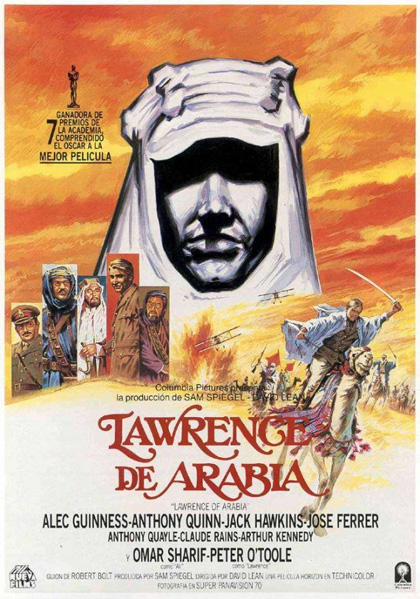
 having never seen it before this weekend's presentation at the Tennessee Theatre (i had been holding out for the big screen), Lawrence Of Arabia was an interesting surprise to me. i'd expected an epic, and an epic it certainly is, the sort that Hollywood has forgotten how to make - it's not just the size of the canvas but also the level of detail you place on it, and Lawrence draws fine, patient lines where today's outsize spectacles throw broad, lazy strokes. yet it's not these lines that really matter in the film, but what's between them: a careful (though occasionally oblique, and frustrating) character study well-merited by a figure of such mystique. it would have been enough for the film to wrestle with itself over whether T.E. Lawrence (played with a distinct otherworldliness by Peter O'Toole) is a noble warrior or a patronizing, narcissistic creature of dangerous folly, but Lean and screenwriter Robert Bolt smartly pester the audience with a further question only they can answer: does it matter that he's both?
Monday, August 06, 2007
david lean's LAWRENCE OF ARABIA (1962)
having never seen it before this weekend's presentation at the Tennessee Theatre (i had been holding out for the big screen), Lawrence Of Arabia was an interesting surprise to me. i'd expected an epic, and an epic it certainly is, the sort that Hollywood has forgotten how to make - it's not just the size of the canvas but also the level of detail you place on it, and Lawrence draws fine, patient lines where today's outsize spectacles throw broad, lazy strokes. yet it's not these lines that really matter in the film, but what's between them: a careful (though occasionally oblique, and frustrating) character study well-merited by a figure of such mystique. it would have been enough for the film to wrestle with itself over whether T.E. Lawrence (played with a distinct otherworldliness by Peter O'Toole) is a noble warrior or a patronizing, narcissistic creature of dangerous folly, but Lean and screenwriter Robert Bolt smartly pester the audience with a further question only they can answer: does it matter that he's both?

Saturday, August 04, 2007
paul greengrass' THE BOURNE ULTIMATUM (2007)
 Greengrass is at this point responsible for two of the decade’s finest, most affecting films in Bloody Sunday and United 93, so it seems a little strange that he’s also behind a pair of its most breathless, rollicking action flicks, but it’s the gravity and apparent lack of polish that make The Bourne Supremacy and The Bourne Identity such essential, encouraging mainstream fare. in Ultimatum an impeccably beefy Matt Damon (nearly unrecognizable next to the bucktoothed smile in a few carefully recycled flashbacks) continues his reign of terror upon the people who so tragically made him into such a badass, and Greengrass once again drags the audience by the gut through a minefield of dense conspiracy and virtually nonstop action setpieces, his camera shimmying and shaking all the while in a verité whirlwind of combat best observed during a hand-to-hand fight to the death during which neither the musical score nor the audience dare make a sound. earlier this summer Live Free Or Die Hard scored points by looking amiably back at the whiz-bang of 90s action, but it’s nice to know that the Bourne films continue to grow in popularity by keeping their eyes fixed firmly forward.
Friday, August 03, 2007
billy wilder's ACE IN THE HOLE (1951)

not long before the end of "Portrait Of A 60% Perfect Man", the centerpiece special feature on Criterion's spectacular new DVD release of Billy Wilder's Ace In The Hole, film critic Michel Ciment is unfortunate enough to voice an observation about the warming romanticism of Wilder's later work, at least in comparison with the good-natured acerbicism of his best-known films. the 74-year old Wilder, ambling around the patio of his California home, immediately perks up in his own defense. "Don't say that," he fumes playfully. "I want to be known as a cynic, as somebody with a vitriolic tongue, I like that much better. I don't want to be known as a softie." Wilder is obviously amused, but there's little to suggest that he's not perfectly serious.
among Hollywood's all-time greats, Billy Wilder has the filmography to back up his claims to such cynicism, however sweet. responsible for films like Some Like It Hot, Sunset Boulevard, Double Indemnity, and The Apartment (to name only the most classic of the classic), the writer-director always sought to push the envelope as he entertained, and took obvious pleasure from highlighting the unsavory corners of the mundane. and it's this aspect of Wilder's creative personality that makes Ace In The Hole, released in 1951 but previously unavailable on home video, such an essential piece: this is Wilder at his most forceful, uncharacteristically disinterested in anything but illuminating society's basest tendencies. it starts mean and it ends sad, and 56 years later it strikes a deeper chord than ever.
the film follows disgraced big-city reporter Chuck Tatum (a fiery Kirk Douglas) as he joins the staff of an Albuquerque daily in an effort to work his way back up the ladder. such an opportunity eventually reveals itself at a pit stop on the way to cover a rattlesnake hunt, where Tatum and his young photographer learn that the filling station's proprietor, in search of Indian relics, has been trapped in an underground shaft. Tatum sees his in and seizes it, deftly tipping the national spotlight to a roadside cliff dwelling and the tasty "human interest story" trapped within, and before long the local sheriff, an excavation contractor, and even the man's own wife are on board to milk power, money, and fame out of the would-be tragedy...even if it means protracting his rescue.
Ace In The Hole was an abject failure upon its release, both commercially and critically, and it's not hard to see why: it's a nasty, bleak portrait of America at its worst, and offputtingly bereft of the witty humor that marks nearly all of Wilder's other work. but it's also fearless in its misanthropy, and uncomfortably prescient, as our news media has done little but slouch toward Tatum's ethically desolate sensationalism in the ensuing years. it’s the subtext to Wilder's ruthless indictment of the burgeoning Media Circus phenomenon, though, that contains Ace In The Hole’s most scathing, and important, lesson: the blame lays as much with the consumer as the producer.
true to form, the Criterion Collection has bestowed Ace In The Hole with an impressive restoration and a collection of supplementary material befitting an American master’s lost opus, from a fine commentary to a handful of lengthy interview pieces, including the aforementioned hour-long 1980 bull session with Ciment. (there’s even a video afterword by Spike Lee, speaking of how the film’s social outrage influenced his own work and proudly showing off a poster signed by Wilder and Douglas.) given both the film’s bottomless relevance and own compelling history (before being essentially buried for half a century, for instance, it was briefly re-released with the “more cheerful” title The Big Carnival), it’s a bit of a shame that the producers of the two-disc set weren’t able to present a bit more about the film itself, but the focus on Wilder is a welcome tribute. and though it’d be unfair to say that Ace In The Hole is one of his very best films, its merits extend beyond its notoriety, and its teeth are as sharp as anything Hollywood has dared to make since.
(from the KNOXVILLE VOICE)
Sunday, July 29, 2007
david silverman's THE SIMPSONS MOVIE (2007)
 maybe the best thing about seeing The Simpsons finally make it to the big screen is watching a perfectly inflated, good-to-very-good caliber episode of the show with an auditorium full of people; as we've all forged our own personal relationships with American humor's most important family unit, it's easy to forget that millions of others all over the world have done the same, and it's honestly fascinating to sit with a group of strangers and see who's responding to what. (that's not to sound snooty, of course, because no matter what facet of The Simpsons' inimitably broad-yet-oddly-specific humor they're responding to, it's still The Simpsons, and odds are it's pretty goddamned funny.) due undoubtedly to the veritable all-star team of contributors from the show's glory days (go on, ask a Simpsons geek who his favorite writers are), the film manages an effortless return to form, inspired in a way few post-heyday episodes have been and tackling a quadrupled running time with easy grace. there are even a handful of canon-worthy gags, including a razor-sharp look at the proximity of Moe's and Lovejoy's and a single, pitch-perfect celebrity cameo. it's funny how a movie literally a decade in the making ended up being one of the summer's least disappointing.
Saturday, July 21, 2007
david yates’ HARRY POTTER AND THE ORDER OF THE PHOENIX (2007)
 though only Prisoner Of Azkaban has thus far been a truly successful adaptation of Potter’s exploits from page to screen, Order Of The Phoenix is the first to really fail; Yates and screenwriter Michael Goldenberg (both making their series debut) have mercilessly hacked their way through the fifth installment’s dark, rich corridors and emerged with what amounts to a poorly-compiled Greatest Hits, relegating most of its surviving characters and subplots to clumsy cameos and asides that may as well have joined the other half of the book on the cutting room floor. abridgement is, of course, a sad reality of adaptation (especially for works as wonderfully, deceptively dense as J.K. Rowling’s) but Goldenberg’s unfocused stabs deal just as much damage to the central narrative, from the negligent muddling of the book’s angsty Dark Side Of The Force themes to the inexplicable excision of crucial events and information, not the least of which being the poignant resolution of Order’s central MacGuffin. (sorry, Neville.) even the climactic Ministry Of Magic sequence, which should have played better on the screen than on the page, is rushed and diminished, most egregiously in the case of a key casualty, robbed by cliché of its devastation. all that said, the film isn’t bad, or, given Chris Columbus’ bloodless initial entries, even necessarily the series’ weakest; its young stars continue to grow as actors, the additions to the cast are characteristically spot-on, and for all the new holes Rowling’s story doesn’t falter in its intrigue. but without the mystery infrastructure of the previous films to prop up the narrative, Yates would have done well to put a little more faith in the intricacies of his source material, and as it stands there’s no excuse for the longest book producing the shortest film.
Sunday, July 08, 2007
michael bay's TRANSFORMERS (2007)
 by and large, Michael Bay gets a bad rap. i myself feel nearly obligated to dislike him, and even the best work in his filmography are films to be defended more than shared, but there's no denying that he's constructed his own outrageous grammar on the groundwork laid by folks like Cameron and McTiernan, and whether or not he's fully hip to the silliness of his stylistic grandiosity is beside the point. what's largely wrong with his worst work, though, is also what's specifically wrong with his Transformers: amid all the gorgeous bluster, there's no dignity, no integrity. that's not to say that a film like Transformers (it's credited source material being "the line of toys by Hasbro") should take itself seriously, per se, but nor should it feel like it was plotted out at a Monday morning Paramount board meeting. the film, overlong by at least half an hour, dawdles at a buffet of computer hackery, military skirmishes, shallow sci-fi, hot chicks, cutting-room floor comic relief, government conspiracy, and teen angst, intent on trying everything and leaving with a stomachache of distancing tonal inertia, and Bay's slick spectacle, fine performances, and jaw-dropping effects are undone by a story that only intermittently engages, and thus rarely thrills. Transformers has a ton to impress, a good bit to dislike, and nothing to love.
leo mccarey's DUCK SOUP (1933) / charlie chaplin's MODERN TIMES (1936)
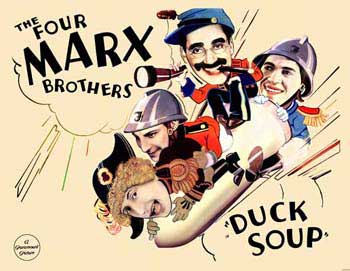
i'm at a loss as to what to say about these two classics/favorites, except that watching them in a glorious double feature highlights the sharp, giddy plane of anarchy that film comedy's early masters were operating on. both lampoon their targets with a frothy (but no less studied, or profound) ruthlessness that still stimulates and incites seventy years later, casting as bright a light as any other scrap of cultural record on how much, and how little, things have changed since Chaplin and Groucho stepped in front of the camera to chide people about blind nationalism, warmongering, uncareful industrialization, and capitalism, even as they harvested knee-slaps and tears of laughter.
"mister firefly, i'm a man of few words..."
"yeah, and i'm a man of one word: scram!"
Saturday, July 07, 2007
mikael håfström's 1408 (2007)
 in some senses 1408 is a valiant effort to reintroduce spooks and scares to the horror game, and in the few moments it really focuses, it does succeed; there's some tantalizing whiffs of mood and macabre austerity during the film's middle section (calling it a second act would misrepresent) and a moment or two of commendably casual terror. but it's also a clusmy adaptation of what seems like a fairly shallow King short story, padded out with pace-constricting grabs at structure and bogged down by a disserviceable slickness. there's probably a damn respectable scary movie to be made from the scraps of 1408, but Håfström's is sadly undone by Hollywood compromise.
Monday, July 02, 2007
brad bird's RATATOUILLE (2007)
 i have to hand it to Brad Bird: he's really putting Pixar's money where their mouth is. it's evident to anyone who's seen any or all of Pixar's first five productions that they've always been laughably far ahead of the curve where both technological innovation and brilliant family-oriented storytelling are concerned, but it was Bird's The Incredibles where they finally, gloriously set foot outside their comfort zone, after which Cars' admittedly broad return to their iconic m.o. felt almost quaint. unlike The Incredibles, Ratatouille does operate within the superficial boundaries of the Children's Film, but Bird's revolution-minded approach to popular animated cinema is unabated; his themes are sharper in spirit yet muted (even obscured), and the narrative is ambitious in its intricacies even as its general thrust is simple slice-of-life as compared to the rest of the Pixar canon. all of this amounts to both good and bad: clutching their safety blanket of emotionally intelligent yet archetypal kid's stories, Pixar consistently grazed pure perfection, while Ratatouille suffers flaws for its wandering eye. but it's still exciting, and necessary, that our most consistent team of filmmakers keep pushing the limits, lest they fall back on a formula destined to tarnish. Ratatouille doesn't hit the sweet spots of, say, Finding Nemo or Toy Story 2, but it's hardly a blemish on their still-spotless record.
len wiseman's LIVE FREE OR DIE HARD (2007)
 i was honestly convinced this was going to be terrible. it's been twelve years since the overlong, racially patronizing, totally sweet Die Hard With A Vengeance sent the trilogy out with a relative bang, and in the meantime the ascendance of CG and superheroes has all but waylaid the hard-R action flick as John McTiernan's original helped define it twenty years ago. fucking awesome, then, that Live Free Or Die Hard is a gleeful, balls-out return to form for the series and the genre at large. Wiseman's action setpieces are thrilling and ridiculous (McClane himself seems to hold back fits of chuckling after every bit of carnage) and despite the PG-13 on the poster, the film never pulls a punch. (or gunshot. or semi-truck vs fighter jet battle.) there are a few misogynistic tendencies (this is, after all, a Manly Man Movie), but there are also some thoughtful preoccupations with machismo's place in the digital age that keep it "current" and self-reflexive without patronizing the audience too much. and though McClane is essentially a superhero himself by this point in the series, it's still nice to see an actioner that succeeds in its wild grabs at its genre's heyday. i went in expecting a neutered retread, and i left having seen the second-best Die Hard.
scott glosserman's BEHIND THE MASK: THE RISE OF LESLIE VERNON (2006)
 though there's certainly a rich, worthy canon, horror is almost certainly the easiest genre to really pin down; both its penchant for shameless trendiness and straightforward goals in regards to its audience make focused deconstruction fairly easy work, and somewhat beside the point. it was with some bit of surprise, then, that i enjoyed and even respected the canny meta-horror at work in Behind The Mask, which follows the crossed paths of an aspiring documentary crew and an aspiring serial murderer as an archetypal spree of slasher-flick terror is painstakingly plotted and realized. Glosserman and co-author David Stieve obviously know their stuff when it comes to the minutiae of convention, but it'd be to little avail without the admirable wit to back it up, and though the first bit of the film exudes a seeming Too-Cleverness, it manages to ride it all the way through into the third act before its inevitable collapse, at which point i was forced to concede that it was Just Clever Enough.
Wednesday, June 27, 2007
steven soderbergh's OCEAN'S THIRTEEN (2007)
 i've read a lot of offhand dismissals of Ocean's Twelve in the press surrounding its followup, which surprises me. it was convoluted, sure, but it also branched out stylistically with balls and bravado while holding onto the first film's simple pleasures, and in that sense Thirteen does it one better, grainily gliding on air for two hours, threatening to float away at any moment. unfettered by love interests, danger and/or intrigue, the story itself is a minimalist, good-natured revenge flick populated solely by charisma and clever mischief, but that's no strike against it given its swaggering escapist gait. there's really a lot to be said for charming, star-studded vanity pictures when they're made with sufficient spirit.
Tuesday, June 26, 2007
alfonso cuaron's PRISONER OF AZKABAN (2004) & mike newell's GOBLET OF FIRE (2005)
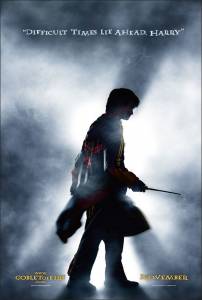 watching it again, it's easy to identify Prisoner Of Azkaban as the best of Harry Potter's screen outings, and it's as much to Cuaron's credit as anyone else's. his Hogwarts (as opposed to Chris Columbus' kiddified tone-down) is better suited to the mysteries and dark times that befall it, and that's symptomatic of the rest of the movie's strengths over the two that came before; Cuaron's realist flourishes give the story a grim grounding it will need as the films progress, and Steve Kloves' smart, subtle changes (vs simple excision) liberate the story from its source material where his other scripts couldn't. once again, the supporting cast is terrific, from Gary Oldman to pinch-hitting Dumbledore Michael Gambon, who brings the character a wry vitality. pity, of course, that pacing problems are built into the time-bending final act, but the film has nothing if not grace to spare.
Newell's Goblet Of Fire, on the other hand, is cursed with Kloves' most leaden adaption - understandable considering the book's length and narrative breadth, but regrettable nonetheless. Goblet hits the notes it needs to for the most part, and the dragon chase is as brilliant as any sequence in the series, but it also makes a few poor decisions where the mystery is concerned, and cuts corners in the larger narrative with surprising recklessness. hopefully Order Of The Phoenix will fare better, and plug some of Goblet's leaks.
Saturday, June 23, 2007
antonia bird's RAVENOUS (1999)
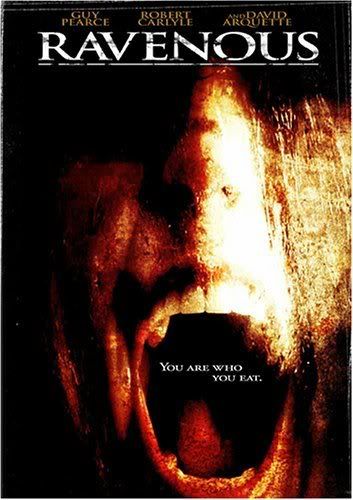 1999 saw the release of a nearly unprecedented batch of offbeat film classics, and among them Ravenous is surely the most underrated, and the only one i return to with any regularity. the cast, scenario, script, tone, look, and score (oh god, the score) are all pitch-perfect and utterly unique. a fun, flawless film that gets better every time i see it.
michael moore's SICKO (2007)
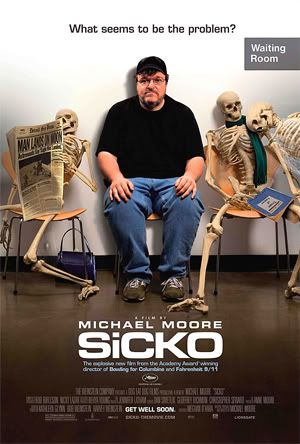 we'll start this where we need to: you already know what you think about Michael Moore. as Fahrenheit 9/11 and its accompanying controversy threatened to wholly commandeer the summer of 2004, it was hard not to take a stance on the portly provocateur, and thanks to his role as F9/11's cheeky protagonist/narrator, even discussion of the film itself eventually veered away from the culture of fear to a cult of personality figureheaded by a smiling, angsty film essayist in a dirty baseball cap. as with most consuming zeitgeists, retrospect reveals a truth somewhere in between the cries of "liar" and "saint"; the film was surely galvanizing and well-meant, but Moore's stagnant ironies and aw-shucks intellectual dishonesty make it hard to return to, as do painful memories of John Kerry's careful squandering of the resulting righteous indignance.
forget all that, though. with Sicko, his fifth nonfiction feature, Michael Moore has found a subject in full harmony with his self-image as a shit-stirring über-populist, approaching our desperately misshapen, ethically bankrupt health care system from an angle that eschews Right or Left, addressing us simply and directly as humans, and, what's more, Americans. where much of his recent work has favored a tone of glib anger, he here tempers his comedy with a quiet, moral sadness, and the result is by no small measure his most restrained, focused and affecting work to date, utterly engaging and enraging from its first frames.
the film opens (after a gem of a Dubya soundbyte) with a short collection of horror stories of the uninsured, including a man who was forced to choose which of two severed fingertips to reattach following an accident. (he opted for the cheaper of the two, paying $12,000 for a restored ring finger.) but this, as Moore soon informs us, is not a film about the uninsured – it's a film about the hundreds of millions of Americans who do have health insurance…and the surprising thinness of the line between the two.
indeed, the first act of Sicko dedicates itself to a devastating exposé of the insurance industry's cackling disdain for its preyed-upon policyholders, and Moore wisely focuses on the individual, from the "insured" (farce has rarely been so ruthlessly poignant as when Moore unshakily announces one woman's fate) to those who operate within the system, including a claims executive doing right by her conscience in front of a Congressional panel. naturally, though, the pols are in on the fix, as illustrated in a sequence detailing the bedroom antics of the medical industry and our legislative branch. (Moore, by the way, should go ahead and consider himself stricken from Hillary's Christmas card list.) this extended lament culminates in a succinct, razor-sharp montage deconstructing the insidious medical-industrial complex and its seemingly irrevocable role in American society, a sequence among Moore's very best work.
but what hope, then, do we have? most of the remainder of Sicko's running time finds Moore and his crew looking to our Western peers for answers. or, rather, one answer: forays to Canada, Britain, and France reveal socialized infrastructures in which all citizens are provided free medical care as a matter of course. such ideas are, of course, subject to scorn and ridicule in the United States, but as Moore affably badgers his way through emergency rooms and chemist's shoppes with wide-eyed incredulity, every bemused foreign smile suggests our own system as a sad, sick joke. no matter your familiarity with socialized medicine abroad, these trips hold some funny and thought-provoking moments, but the thrust of the sequence is consistent, and adamant: even our most staunchly capitalistic brothers and sisters around the world see universal healthcare as a clear moral and ethical imperative. even Moore's journey to Cuba with medically disenfranchised 9/11 workers depicts an obviously healthy government-run healthcare system, including a pharmacy where a cancer survivor is able to purchase her medicine for literally 1/2400th the price she pays in the United States.
this is strong stuff, but in the wrong hands (say, Moore's circa 2003) it might be just another entry in the string of activist nonfiction films for which Bowling For Columbine opened the floodgates – either narratively inert, fatally smug, or both. luckily, the determined humanism of this labor of love seems to have softened the Michael Moore we know and love to hate, or vice versa. Sicko does occasionally find him up to his old tricks, dabbling in ironic stock footage, clumsy pop music, and rhetorical silliness, but it's far less distracting here than in his previous work, thanks largely to a more careful attention to the ideas in play, and the proper way to string them together. he resists unnecessary rants and tangents, and downplays his own role in the proceedings; where Moore took center stage in Fahrenheit 9/11's struggle for truth and propriety, Sicko gracefully cedes the struggle to us, our families, and our friends, in a spirit of heartsick populism.
the film isn’t flawless – there’s a sour note toward the end regarding an act of charity, and the relatively unscathed pharmaceutical industry merited some of the running time reserved for his European jaunt – but it hits hard, and through its pessimism it is fundamentally right-minded. Sicko has, and fully earns, the power to put health care back at the forefront of our national dialogue, and wraps it in a devastating piece of entertainment. Michael Moore, you old buffoon, you done good.
(from the KNOXVILLE VOICE)
Subscribe to:
Posts (Atom)

 Posts


