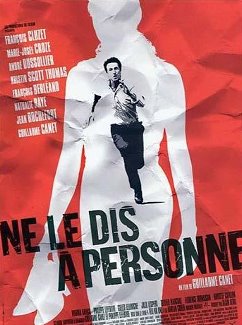
 what is it about the French that they've managed to keep the spirit of Alfred Hitchcock alive as Hollywood's efforts at the suspense thriller have forked off into spectacle and twisty mediocrity? their fascination with him dates back to the dawn of his glory years, as the New Wavers worked to boost his critical standing and directors like Claude Chabrol and Henri-Georges Clouzot found themselves indebted to his genius as they thrived as his peers and rivals.
and it continues today, as currently evidenced by Guillaume Canet's sly, gripping Tell No One, produced in 2006 but only now seeing a US release. adapted from the novel by American mystery writer Harlan Coben, the story itself is a tip-off, and almost too self-consciously so: pediatrician Alexandre Beck (François Cluzet), still mourning his murdered wife after eight years, begins receiving mysterious emails on the anniversary of her death, just as a new development reopens the investigation and places him back under suspicion. the ensuing labyrinth of lies and secrets finds Beck chasing a love from beyond the grave (a la Vertigo) as he himself is pursued for a crime he did not commit (a la damn near half of the rest of Hitchcock's movies.)
Tell No One, however, is not merely imitation or even emulation; Canet (a heartthrob actor with only one previous feature under his belt) lays out his mystery with both focused aesthetic economy and a fierce desire to entertain, and it's the intersection of the two that really evoke the Master Of Suspense, from the interrupted quiet of the opening scenes to a heartstopping centerpiece across eight lanes of traffic.
there are elements here and there that break the spell: an ill-considered smattering of English pop music undermines Canet's good taste, and he puts his foot on the brakes a little too early, leaving the Big Reveal and its aftermath a bit flat. but it's said that the only way to write a mystery is to come up with the ending and write backwards, and Tell No One evidences a logical extension of that: though the final knot of formerly loose ends is as satisfying as it should be, the joy here is in the telling, which in its own novelistic way transcends Hitchcock's more arid orchestrations of suspense. what really distinguishes Tell No One from its Hollywood counterparts is that beneath the confident slickness is a dense thriller that takes itself, and the audience, seriously.
 it seems a little unfair, though, to pick on American suspense thrillers just as Brad Anderson's latest effort arrives in Knoxville as well, fundamentally different though it may be from Tell No One's literate riddling. (perhaps the film's complete reliance on European funding excuses it.) the cold, claustrophobic Transsiberian follows American couple Roy and Jessie (Woody Harrelson and Emily Mortimer) as they traverse by rail through the badlands of Russia on the way home from a Chinese mission trip, befriending another young couple and a Russian detective (Ben Kingsley) along the way.
no, the couple are not what they seem. and yes, the detective is one step ahead of everyone else. these are not Transsiberian's surprises. what is surprising is where the story goes with these worn elements, and how it gets there. (besides the train -- itself an old standby, especially if we're still talking about Hitchcock.) Anderson unfolds his story unhurriedly, and depends as much on the audience's expectations as the story itself to provide the unease. we gradually get to know Roy and Jessie, occasionally all the better through contradicted perceptions of them, and we attempt to divine the intentions of their traveling companions.
and then, finally, plans are disrupted, though the film continues its deceptively carefree pacing right up to the inevitable (yet thoroughly unexpected) eruption, after which Transsiberian fulfills its coy promises on substantially altered terms. there is deception and considerable suspense, all enhanced by the backdrop of a train barrelling across the tundra, its passengers cornered in the snow white vastness.
sadly, though, there is also final act that takes our upended expectations and squanders them on noisily strained credulity. the story's slow, careful acceleration demands an eventual release, but Anderson (excepting a spectacularly foiled trip to the dining car) provides it largely through shouting and gunplay, and in doing so steers the film straight back toward, if not directly into, the territories of a more mundane thriller. Transsiberian is a noteworthy effort from a director that continues to impress (The Machinist still haunts), but that makes it all the more disappointing when the train finally loses its steam.
(from the KNOXVILLE VOICE)



 Posts
Posts


