Showing posts with label sci-fi. Show all posts

Tuesday, November 11, 2008

dwayne carey-hill's BENDER'S GAME (2008)

sad news from last week: Fox has announced that Mike Judge's quietly superb King Of The Hill will end its thirteen-season run this spring, carving their Sunday night schedule a gaping hole of character-driven comedy and humanism into which they will toss a third (count 'em) weekly half hour of Seth MacFarlane's insipid comedic panhandling. the good news? noted programming scavenger ABC may be in talks to bankroll a fourteenth season of the show to keep Judge's newest animated effort, The Goode Family, company.

hopeful, yes. but necessary? there are at the very least lessons to be learned from fellow Fox cancelee Futurama, which debuted its third feature-length effort Bender's Game early this month. like King Of The Hill, Matt Groening's goofily literate sci-fi cartoon was treated to aggressive negligence by the network over the course of five staggeringly consistent seasons, and though it proved far less fortunate when it was axed unceremoniously in 2003, cable reruns and DVD eventually brought the show the audience it deserved. the unlikely result: a series of four straight-to-video features, eventually to be chopped up for use as a sixth "season" on Comedy Central.

but, alas, there is the Pet Sematary factor: resurrections aren't always what they're cracked up to be. last year's time-travel caper Bender's Big Score kicked the series off on a confident high note, but June's The Beast With A Billion Backs was somewhat less encouraging, and the latest effort does little to best it. As evidenced by the title's Orson Scott Card nod, Bender's Game still traffics in Futurama's immersive wit, and the film is surely good for 87 minutes of laughs from the faithful; from the characteristically clever fuel crisis topicality to a third act that dumps our 30th Century heroes into a Middle Earth-esque alternate reality, there is plenty of story to go around, and most of the series' expansive, beloved cast is given face time.

the keys to Futurama's unique excellence, though, remain conspicuously absent from most of Bender's Game. The conceptual heft and disarming emotional resonance that mark the show's best moments (both on healthy display in Bender's Big Score) here take a decided backseat to broader, less ambitious gags, and the writers' obvious struggle with the demands of their feature-length canvas only enhances the sour taste of missed opportunities. it's still damn good to have you back, Futurama, but let's hope February's Into The Wild Green Yonder does a little more to really earn that second chance.

(from the KNOXVILLE VOICE)

Tuesday, September 02, 2008

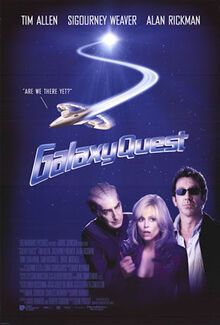
dean parisot's GALAXY QUEST (1999)

i've always heard reserved-but-still-unreasonably-complimentary things about Galaxy Quest, and understand them quite well after seeing the movie: here is a determinedly three-star flick that could not really be any better. (that last part is a little ambiguous, but i mean it in the nicest way possible.) the scenario is genuinely clever, if not altogether ambitious, and the no-name writers and director earn their pay alongside a cast that (particularly in the case of Enrico Colantoni, as the smiley, spastic leader of an alien race) obviously had a lot of fun. entertainment at it's most inconsequential is entertainment still.

Monday, August 18, 2008

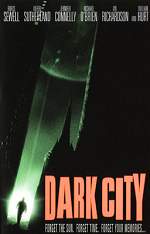
alex proyas' DARK CITY: THE DIRECTOR'S CUT (1998)

in the final couple of years of the twentieth century a heady sort of trend emerged in science fiction film; reacting largely to technology's progressing effect on the human experience, The Matrix and a handful of lesser tagalongs wrapped up notions of reality and experience in a bow of paranoiac sci-fi capering. the easy pinnacle of this mini-genre, though (now that we can all agree on The Matrix as little more than a rad tech demo) is the one that takes its cues from deep fantasy rather than virtual reality: Alex Proyas' 1998 stunner Dark City, which follows an apparently murderous amnesiac (Rufus Sewell) through the streets of its titular metropolis as he investigates his own emerging telekinetic powers as well as a race of pasty "Strangers" who may or may not be bending reality to their own sinister purposes.

silly as its synopsis may sound, Dark City's gorgeous, austere blend of fantastical sci-fi and film noir has gained an enthusiastic following since its initial box office sputter (Roger Ebert champions the film as 1998's single best), and the newly prepared Director's Cut should only improve its standing. most of the changes are minor, even unnoticeable, but it's the big one that makes the difference: gone is the theatrical release's studio-mandated opening narration and montage, which together gave away egregious chunks of information about the nature of the Strangers.

the result is a much more suitably mysterious film, as these antagonists and their visually wondrous methods are afforded the introductions and impact they deserve, reinforcing Proyas' strong vision for what the disc's special features reveal to be a film of great personal importance to him. it's generally true that the "alternate cut" has lately become as much a way to move DVDs as a deference to the filmmaker, but fans of the film (and even moreso those seeing it for the first time) will be glad to know that this one moves an already underrated film squarely into the upper reaches of the sci-fi canon.

(from the KNOXVILLE VOICE)

Tuesday, April 01, 2008

richard kelly's SOUTHLAND TALES (2006)

"evacuate the atrium, move to the rear of the mega-zeppelin."
- Dwayne "The Rock" Johnson (as Boxer Santoros), delivering the best line of his storied career


finally released on DVD after years of tweaking and an embarrassingly minor theatrical run, Richard Kelly’s Southland Tales is the story of a dimwitted porn star, an amnesiac conservative actor, an alternative energy baron, the head of a national surveillance agency, a ice-cream truck driving arms dealer, bong-huffing neo-Marxist extortionists, a southern senator, a soldier slinging a drug called Liquid Karma, and two suspiciously identical policemen, among many others. an attempted summary of the film’s story would turn into a list twice as long, as full of tangents and halfbaked notions as genuine plot points. Southland Tales is a movie of Ideas, and it wants you to know that. it’s cerebral, but also deadly silly and stupid.

more than anything, though, the key descriptor for Kelly’s follow-up to his much-loved, much-puzzled-over Donnie Darko is audacity. for the first twenty minutes, it’s hard to shake the feeling that the whole thing’s just a big joke, as a scarred-up Iraq veteran (Justin Timberlake) introduces us to a present-day post-apocalypse California, our primary players, and leagues of paranoiac backstory set to a series of glossy, over-designed effects. considering Kelly cut forty minutes out of the film following a positively disastrous Cannes screening, it’s hard to begrudge him the unfortunate Band-Aid of awkward exposition, but the scope of what he introduces, the obviously non-chewable bites he takes right off the bat, still leave you primed for the biggest cinematic goof since Freddy Got Fingered. (or at the very least Lady In The Water…that one was a joke, right?) and for an hour afterwards, it just plods forward without particular drive or interest.

then a funny thing happens: everything starts falling together. not in the way Kelly probably envisioned as this bloated clown originally emerged from his word processor, mind you, but falling together nonetheless. throughout Southland Tales’ running time it pretends pathetically to the thrones of Vonnegut, Robert Altman and Philip K Dick, but when it’s honest with itself there’s really quite a lot to be said for the film as a sort of slick, maximalist heir to Repo Man. it’s a shaggy dog story full of metaphysical lunacy and infuriatingly dense storytelling, with none of the patient, melancholy character work that make Donnie Darko so beguiling. but whether it deserves it or not, it redeems itself in small ways amid the mess, and ends up working unexpectedly well on its own terms, which is all you can really ask of it. it’s not hard to see why so many have tossed Southland Tales aside as a disaster, but the curious shouldn’t be dissuaded.

(from the KNOXVILLE VOICE)

Monday, March 17, 2008

joss whedon's SERENITY (2005)

how embarrassing for George Lucas that the summer of Sith should come to an end with a piece of science fiction that succeeds so wildly on every level that his Star Wars prequels failed. with Serenity Whedon gives his nearly-perfect Firefly the grandest sendoff imaginable without skipping a beat; the finale is every bit as lively, inspired, and downright fun as the series' best, but it's also astonishingly comfortable as a feature, and as much as Whedon impresses as a first-time director, it's still his writing that steals the show. i'm not talking about the trademark banter (which, in another trademark, occasionally misfires), but rather the spotless transition of scope and structure from hourlong to feature length that shines a light on Whedon as a trully accomplished screenwriter; the bravura opening sequence alone is a graduate class in both construction and unobtrusive exposition, pulling the uninitiated into Firefly's universe with one hand and giving old fans a welcoming pat on the back with the other. whether it's television, film, or even comics, there's little excuse for people not to be constantly throwing money at Joss Whedon.

james cameron's THE TERMINATOR (1984) and TERMINATOR 2: JUDGMENT DAY (1991)

i hope when James Cameron sits back and reflects proudly on his career (which he probably does on an hourly basis or so) the Terminator movies get their proper due; though i'd probably say Aliens is his best work, Judgment Day creeps closely behind, and part of the latter's success is the full embrace of a rich mythology hinted at in the first film, a mythology that continues to fuel the brand 25 years later. (that the original now seems a bit tedious is only further credit to its sequel's wall-to-wall spectacle; it's a pretty accomplished lowish-budget piece of sci-fi.) the one thing that still troubles me, though, is that such a fully, arguably unnecessarily realized backstory relies so heavily on an obvious (and, thanks to persistent oversight, irreconcilable) paradox within its time-bending premise: if Sarah Connor were ever to find true, lasting success in her campaign to stop SkyNet, her beloved son would surely blink out of existence, and she would once again find herself a sadder, older version of the vapid clubrat we meet at the beginning of the first film...which would once again leave SkyNet unprevented and unopposed. (this is all, of course, assuming that space/time doesn't rupture and destroy everything post-1984, though if that were the true nature of Terminator's time travel philosophy, it probably would have happened eight times over by Judgment Day's climax.) the only other explanation is that all the holes and folds in time throughout the films are already accounted for in a grander timeline, which means that there's no changing or stopping mankind's fate, no matter how many picnic tables are etched up with facile assertions of free will.

Wednesday, February 20, 2008