
Thursday, July 10, 2008


alfred hitchcock's VERTIGO (1958)
 the Tennessee Theatre's "Summer Movie Magic" series is once again in full swing, populating our local treasure's silver screen with everything from perennial snoozers (Gone With The Wind) to more adventurous selections (Thunder Road's fiftieth anniversary) and underseen classics (It Happened One Night), and this weekend in particular brings perhaps the most exciting, must-see entry in this year's varied lineup: Alfred Hitchcock's masterpiece-among-masterpieces, Vertigo.
 the story of an acrophobic former detective (Jimmy Stewart) tasked with tailing an associate's mysteriously afflicted wife (Kim Novak), Vertigo met a lukewarm reception upon release in 1958, and in a way it's not hard to see why; Hitch's genteel psychosexual melodrama contrasts rather drastically with the crowd-pleasing potboilers he'd been putting out for more than twenty years at that point, and the film is indeed so introverted that it hands out the solution to the central mystery well before it needs to simply because it serves the psychology.
this is not to suggest that Hitchcock sets aside his Master Of Suspense mantle for a single moment; Vertigo still exudes pure mystery (it was, in fact, recently named the genre's greatest film by the AFI) and beguiles with every twist and turn. the difference, though, is that Hitchcock (with screenwriter Samuel A. Taylor, adapting a French novel allegedly written specifically for Hitchcock) here narrows his focus to the mind -- Stewart's darkening obsession, Novak's fractured identity -- and emerges with a more profound mysteriousness than exists elsewhere in his storied body of work.
what may be the key to Vertigo's ever-expanding reputation, though, is that such internalized intrigue leaves Hitchcock free to dabble carefully with the look and feel of the film, and the result is quite simply perfection. Stewart, composer Bernard Hermann and cinematographer Robert Burks all collaborated fruitfully with Hitchcock throughout their careers, but Vertigo remains the deepest, most challenging work any of the four men ever produced. If North By Northwest is Alfred Hitchcock's gift to the audience, and Psycho his gift to the cinema, then Vertigo is nothing less than his gift to art at large, and the opportunity to see it on the big screen should not be passed up.
(from the KNOXVILLE VOICE)
jody hill's THE FOOT FIST WAY and steve conrad's THE PROMOTION (2008)
there's an important bit of screenwriting wisdom stressing the odd but undeniable truth that comedy is a much harder thing to write than drama. where dramatic pieces only necessarily require the tangible minimums of storytelling (scenario, character, conflict) and leave everything else wide open, even the stupidest of comedy scripts ideally involves painstaking attention not only to what is or is not funny but also how to package it; after all, miscalculations in tone, pacing, or performance can conceivably mean the difference between belly laughs and bad times. (see: The Love Guru.)
(just kidding, please don't see The Love Guru.)
even harder is consideration of the comic character, which folds its requirements back into the more complicated realms of drama. it's not quite important that we believe the characters could exist (it's sufficient to understand how they might), but constructing a story around them requires something more: an emotional connection, however slight, is what keeps audiences in the seats even when the jokes start to spoil.
 it's a credit to Jody Hill, then, that his The Foot Fist Way almost manages to succeed as a comedy despite careless disregard for any and all of these guidelines. here is a microbudgeted film (shot in Concord, NC) that remains microbudgeted in spirit, from the indifferent staging and inert pace to the woefully modest scope of its story, and for the most part lacks the sort of inspiration that typically leads a group of friends to make a feature film. throughout the running time there is vulgarity, misanthropy, awkwardness, and even misogyny.
ah, but there is also Danny McBride. perhaps recognizable to some from stolen scenes in David Gordon Green's underappreciated romance All The Real Girls or the probably-suitably-appreciated Hot Rod, the pudgy, mustachioed McBride plays Fred "King Of The Demo" Simmons, a small-town Tae Kwon Do instructor with an unfaithful wife, somewhat dubious credentials, and few friends beyond the children and smattering of adults that faithfully attend his dojo. there is a bit (only a bit) more to the story, but it's fair to say that the focus is much more on McBride than anything to do with the plot, as he gifts the almost forgettable film with a towering, ferociously deadpan comedic performance that has already facilitated his clean jump into mainstream comedy. (next up: a supporting role in Green's Apatow-produced stoner thriller Pineapple Express.) from getting riled up about 2-for-1 crab legs to cornering a pretty student with thickheaded advances, Fred Simmons is a living, breathing (and unmistakably Southern) dumbass, and McBride gives the comedic turn of the year so far.
until, that is, the film finally collapses under his weight. the amateur cast makes The Foot Fist Way's sloppy chug that much slower, and in the end the whole thing is done in by its limitations. though Fred Simmons is an undeniably funny character, neither the filmmakers nor the audience manage anything approaching real empathy on his behalf, and being put-upon and cheated on don't carry that much weight when we're indifferent to their victim's plight. The Foot Fist Way will doubtlessly achieve cult longevity (it was distributed by Will Ferrell, who would likely chair the film's fan club) but it's much more of a raw showcase than a comedic film.
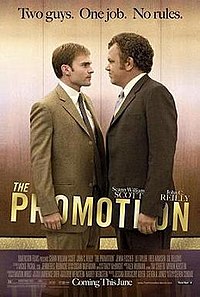 Steve Conrad's The Promotion, on the other hand, has an embarrassment of riches where emotional identification is concerned. the story of two Chicago men (Seann William Scott and John C. Reilly) competing for the managership of their grocery chain's nearest location is ripe enough material for a light dramatic comedy by itself, but Conrard shakes things up by approaching the rivals with equal sympathy and intelligence, ensuring in the process that each member of the audience's moment-to-moment alliances will not only shift but do so independently of everyone else's.
the film is presented primarily from Scott's perspective (the narration is among the tonal debts to Alexander Payne's kindred Election) but we grow increasingly weary of his white lies and poor impulse control; Reilly, on the other hand, emerges as a shady, Canadian usurper to Scott's grocer throne but ends up charming with his innocence. over the course of the movie each man makes decisions and acts in ways that speak alternately well and ill of his character, and we are asked to determine for ourselves the worthiness of each choice.
The Promotion is nuanced, emotionally intelligent, and above all humanistic in a way few films are. Conrard (making his debut behind the camera after writing The Weather Man and The Pursuit Of Happyness) continues to explore the way people define themselves by the work they do, for better or worse, and when the dust settles on the titular promotion it's hard not to feel simultaneously glad and disappointed in the outcome. there are more hard laughs to be found in Foot Fist Way, but why bother with a caricature when the real thing is so much more satisfying?
(from the KNOXVILLE VOICE)
(just kidding, please don't see The Love Guru.)
even harder is consideration of the comic character, which folds its requirements back into the more complicated realms of drama. it's not quite important that we believe the characters could exist (it's sufficient to understand how they might), but constructing a story around them requires something more: an emotional connection, however slight, is what keeps audiences in the seats even when the jokes start to spoil.
it's a credit to Jody Hill, then, that his The Foot Fist Way almost manages to succeed as a comedy despite careless disregard for any and all of these guidelines. here is a microbudgeted film (shot in Concord, NC) that remains microbudgeted in spirit, from the indifferent staging and inert pace to the woefully modest scope of its story, and for the most part lacks the sort of inspiration that typically leads a group of friends to make a feature film. throughout the running time there is vulgarity, misanthropy, awkwardness, and even misogyny. ah, but there is also Danny McBride. perhaps recognizable to some from stolen scenes in David Gordon Green's underappreciated romance All The Real Girls or the probably-suitably-appreciated Hot Rod, the pudgy, mustachioed McBride plays Fred "King Of The Demo" Simmons, a small-town Tae Kwon Do instructor with an unfaithful wife, somewhat dubious credentials, and few friends beyond the children and smattering of adults that faithfully attend his dojo. there is a bit (only a bit) more to the story, but it's fair to say that the focus is much more on McBride than anything to do with the plot, as he gifts the almost forgettable film with a towering, ferociously deadpan comedic performance that has already facilitated his clean jump into mainstream comedy. (next up: a supporting role in Green's Apatow-produced stoner thriller Pineapple Express.) from getting riled up about 2-for-1 crab legs to cornering a pretty student with thickheaded advances, Fred Simmons is a living, breathing (and unmistakably Southern) dumbass, and McBride gives the comedic turn of the year so far.
until, that is, the film finally collapses under his weight. the amateur cast makes The Foot Fist Way's sloppy chug that much slower, and in the end the whole thing is done in by its limitations. though Fred Simmons is an undeniably funny character, neither the filmmakers nor the audience manage anything approaching real empathy on his behalf, and being put-upon and cheated on don't carry that much weight when we're indifferent to their victim's plight. The Foot Fist Way will doubtlessly achieve cult longevity (it was distributed by Will Ferrell, who would likely chair the film's fan club) but it's much more of a raw showcase than a comedic film.
Steve Conrad's The Promotion, on the other hand, has an embarrassment of riches where emotional identification is concerned. the story of two Chicago men (Seann William Scott and John C. Reilly) competing for the managership of their grocery chain's nearest location is ripe enough material for a light dramatic comedy by itself, but Conrard shakes things up by approaching the rivals with equal sympathy and intelligence, ensuring in the process that each member of the audience's moment-to-moment alliances will not only shift but do so independently of everyone else's. the film is presented primarily from Scott's perspective (the narration is among the tonal debts to Alexander Payne's kindred Election) but we grow increasingly weary of his white lies and poor impulse control; Reilly, on the other hand, emerges as a shady, Canadian usurper to Scott's grocer throne but ends up charming with his innocence. over the course of the movie each man makes decisions and acts in ways that speak alternately well and ill of his character, and we are asked to determine for ourselves the worthiness of each choice.
The Promotion is nuanced, emotionally intelligent, and above all humanistic in a way few films are. Conrard (making his debut behind the camera after writing The Weather Man and The Pursuit Of Happyness) continues to explore the way people define themselves by the work they do, for better or worse, and when the dust settles on the titular promotion it's hard not to feel simultaneously glad and disappointed in the outcome. there are more hard laughs to be found in Foot Fist Way, but why bother with a caricature when the real thing is so much more satisfying?
(from the KNOXVILLE VOICE)
Wednesday, July 02, 2008


jon hurwitz & hayden schlossberg's HAROLD AND KUMAR ESCAPE FROM GUANTANAMO BAY (2008)
 catching a dollar showing on a whim, it's hard not to wish i'd chosen to see H&K the night i grimaced through Baby Mama; there's something special about the rarefied breed of comedy that attempts very little and ends up succeeding enormously on its own terms. like the original Harold & Kumar, ...Escape From Guantanamo Bay treads good-naturedly through the episodic capers of its titular stoners, from a plane to Amsterdam (it picks up nearly immediately where the last one left off) to Gitmo to the American South and finally to Crawford, Texas, where Harold & Kumar share a puff or two with what may long stand as the friendliest portrayal of Dubya in a feature film. it's a thoroughly dumb movie, but also disarmingly likable and even occasionally clever; its satire manages to be at once gentle and over-the-top, and it finds surprisingly genial ways to ridicule both racial prejudice and the fever pitch of America's war on terror. it is what it is, and i wouldn't send anyone in unprepared for that, but if you're willing to go along with it Harold And Kumar Escape From Guantanamo Bay is one of the funniest films of the year so far.

errol morris' STANDARD OPERATING PROCEDURE (2008)
 "When you're in war, things change."
- Spc. Jeremy Sivitz
amid the unending controversy and contentiousness surrounding the United States' military occupation of Iraq, the revelations in early 2004 of prisoner abuse at Abu Ghraib prison remain the longest, darkest shadow over our continuing presence in the Middle East. while opinions about the war and its prosecution vary from person to person all over the world, the reaction to the Abu Ghraib photographs was unified: in the humiliation of these men, whatever their crimes, was the humiliation of an entire nation already struggling (and struggling to this day) to convince itself and others of the righteousness of its task.
perhaps as tragic, though, was the whimper with which American society eventually edged Abu Ghraib out of its consciousness. after months of soul searching and hand-wringing on the public's part (and no small amount of posturing from every corner of the political sphere) the Bush administration won the day by doling out prison stints and dishonorable discharges to the low-ranking soldiers involved, and brushing off any notion of any further culpability. simply a matter, we were told, of the proverbial bad apples.
such an blithe dodge to such a monumental issue is, of course, fertile ground for the sort of fluffy, finger-pointing activist documentaries Bush has so generously inspired these past eight years, which makes Errol Morris' Standard Operating Procedure that much more important: America's most distinguished, inspired nonfiction filmmaker, Morris here engages on a moral and intellectual level rather than a political one, and remains steadfastly inquisitive in the face of an inconceivably bleak subject. he is fascinated by the reality that Lynndie England and her compatriots are both victim and perpetrator, and cognizant that the circumstances of their monstrousness have deep roots and broad implications; while the endgame of scapegoating and political maneuvering are certainly worthy of scrutiny, Standard Operating Procedure is far more interested in the grander narrative of war and humanity.
not unusually for Morris, the film hinges around a series of interviews. we hear from former Brigadier General Janis Karpinski, insistent that everpresent U.S. intelligence operatives set the tone for the treatment of prisoners; from Tim Dugan, a non-military interrogator working at the prison and attesting to lack of useful intelligence emerging from its chambers; from Brent Pack, a special investigator tasked with interpreting the photographic evidence and, in one of the film's most chilling sequences, delineating the thin legal distinctions between "criminal acts" and "standard operating procedure."
most illuminating, though, are Morris' sit-downs with the offending soldiers, who speak candidly despite an almost visible weight of regret and even confusion. Spc. Sabrina Harman explains of a big smile and thumbs-up in frame with a dead interrogatee as a reflexive snapshot pose. Spc. Jeremy Sivitz speaks of his family's good military name dragged through the mud because he was unwilling to voice his objections to the superior officers involved, while Sgt. Javal Davis describes spending his days guarding Iraqi detainees while the fruits of their countrymen's labor sent US soldiers home in boxes draped with flags, and how that anger and confusion manifests itself when military intelligence officers start encouraging the guards to "soften up" the detainees.
we even hear from Lynndie England herself (looking now somewhat less like a stoned teenage boy) as she discusses spending the early hours of her twenty-first birthday in the throes of an Abu Ghraib all-nighter, and speaks distantly of a love (for abuse ringleader Cpl. Charles Graner) that blinded her to the ramifications of her actions, which included posing for or taking many a famous photograph.
if there is more than the suggestion of apology or rationalization in these soldiers' words, it has been left on the cutting room floor. instead, the film's participants seek only to clarify -- to take this opportunity to speak their piece. it is devastating, but we see in the end that they are ordinary people put in extraordinarily horrible circumstances for which there is little context. we do not forgive, but we inch toward understanding.
there is all of this and much more in Morris' savagely lucid film, which is every bit as hypnotic as 2003's Fog Of War or indeed any of his other work. his sense for structure remains impeccable, and he even ups the visual ante with striking graphics work and evocative, bleached-out "reenactment" footage that makes an impression without upending the film's harsh reality.
in the end, though, it's not his considerable gifts as a stylist or technician that make Erroll Morris such a force in nonfiction film -- it's his knack for extracting the truth, whether from images, words, or even faces. and while Standard Operating Procedure may be necessarily short on objective answers about the horrors of Abu Ghraib, it remains encouraging for us all that there is that much more light cast on a dark hour.
(from the KNOXVILLE VOICE)
Friday, June 20, 2008

louis leterrier's THE INCREDIBLE HULK (2008)
 so now that it's all done with, was this really necessary? Iron Man's unqualified creative success tipped the scales on whether or not the Hulk reboot might be worth my time (i am, after all, a fan of both Norton and Leterrier), but i'm sad to say my initial reactions were correct: The Incredible Hulk is a waste of time, money, and talent, and does not one thing better than Ang Lee's version. the action sequences are bigger and more plentiful, sure, and the TV series' Banner-on-the-run premise is a superior frame for a good Hulk story, but the overwhelming emotional ineptitude makes much of the film very nearly boring. (few seem reluctant to label Lee's Hulk as a snoozer, but at least there was something going on upstairs.) on its own terms The Incredible Hulk is a B- comic book movie, but following a previous, just-fine version by a few years and a flawless, intertwined crowd-pleaser by mere weeks it's nothing less than a failure.
Tuesday, June 10, 2008
frank darabont's THE MIST (2007)
 Darabont seems so professionally taken with the work of Stephen King that it's a little sad he doesn't really have the chops to make an actual horror film; i've got patience enough with his genial mediocrity, but The Mist bites off a little more than he can chew. there's a good bit to admire in his adaptation, from the portrait of ugly religious fervor (one wonders how a pared-down Mist might work on the stage) to it's heavy, audacious ending -- Darabont's heart was in the right place, and moreso his balls. but the movie that surrounds both his and King's better ideas is clumsy at best and corny at worst, plagued by hammy performances, inert staginess, and an apparent loss as to how to cut the film together without the odd Fade To Black, the sum result of which is a film far too confident in its potential to captivate.
still, just to rub sand in The Strangers' eyes, it must be said that this is a mainstream film with a bold bleakness that still manages to entertain and provoke thought. whether or not it earns the ending is perfectly arguable, but either way those last moments are saturated with desperate love rather than crass hatred, and there's simply no contest between the two, whatever their purpose.

bryan bertino's THE STRANGERS (2008)
 what are the terms of the contract between a work of horror and its audience? it’s an interesting question with regard to any and all of the genre’s forms, from oral tradition to Stephen King, but it’s most pressing where the horror film is concerned: we’re asked, there in the dark, to place our trust in a variety of terror that will engage us on its own visceral terms rather than those tethered to our imaginations, and what we generally ask in return is to find entertainment in the provocation of our fears. horror fans come in many forms, of course, from the desensitized gorehound to the teenage girl two rows in front of you that collapses in laughter after each shriek without pausing to breathe; so, too, do the movies themselves run an astonishing gamut of styles and sensibilities, each wholly inappropriate for the wrong sort of audience. but the contract remains, and no matter how perverse the escapism is, it's still perfectly reasonable to expect that escape.
in many ways The Strangers is an exemplary American horror thriller, and a confident, undeniably auspicious debut for writer/director Bryan Bertino. the story is minimal, sure, and not entirely unfamiliar: two young lovers (Scott Speedman and Liv Tyler) find themselves alone in a remote summer home as a trio of masked interlopers, motive-free save for bloodlust, attack them unremittingly through the night.
it's a premise that demands quite a lot from its execution, and Bertino is up to the challenge. this is the rare horror film in which aspiring survivors do not simply run amok, lapsing in judgment at the plot's cruel whims; they are instead drawn as finely as the brisk running time will allow, and act with logic and dignity throughout. we are scared with them because we are ushered comfortably into their heads, and we root for them because we are unable to remove ourselves from the overwhelming doom. the film is intimate, even claustrophobic, and once the terrorizing begins it is never unclear that two against three are vastly unfavorable odds.
aesthetically, too, the film is accomplished. though Bertino cribs his creeps and crawls from elsewhere (particularly recent European horror) it all marries together handsomely, from the slow, sure burn of the first act to the nail-biting melee of the third. the antagonists' simple, striking masks (one little more than a small burlap sack) carry the innuendo of inhumanity as their figures initially fade into and pop out of the careful frames, and later suffocate any hope of mercy, or even the barest explanation. there is creepiness to spare in every empty room, creak or sudden twist of the head, until the film tires of being creepy and throws the curtain aside on a symphony of loud, unforgiving malevolence. there is relatively little by way of the graphic violence, but graphic violence would be beside the point -- the violence has long since crept from the screen and into our own helpless engagement.
more important than its craft, however, and more important than its power, is this: The Strangers is first and foremost a work of irredeemable garbage.
there are, of course, those who would say the same thing about any given horror film, with varying degrees of validity. and there's damn sure little to defend the spate of witless, sadistic Xeroxes currently masquerading as mainstream American horror. but what makes The Strangers so egregious, so thoroughly immoral, is that it's very tangibly a worthy genre entry; its artifice and effectiveness preclude the sort of dismissal we might reserve for, say, One Missed Call or whichever numeral they're remaking Saw under this year. it demands and even deserves to be taken seriously, to the degree that when the lights come up and we realize we've just seen a glorified snuff film while Kung Fu Panda played next door, there's little to do but take the entire genre to task, and ourselves as its accomplice.
but that's a trap. The Strangers' real crime, the one that so readily outshines what might otherwise be called virtues, is that behind its polish there is nothing intended to provoke thought or entertainment; it's a glib construction existing only to manipulate your fears and sour your stomach about the depths of human nature. (worst of all the film plays out under the auspices that it was "inspired by true events", a transparent stab at legitimizing its bleak, abhorrent ending.) more than anything else The Strangers seems a tailor-made validation of Michael Haneke's wry, inscrutable Funny Games, which actively chides and goads its audience for daring to eke entertainment from a murderous home invasion sure to end badly for any innocent with the misfortune to be involved. here, in The Strangers, is the same film lobotomized, substituting slick, sick panache for an inkling of thought or conscience.
this is not what horror film is about. the best of them parade wit, joy, ingenuity, and subtext, while even the worst can rely on intrigue and formula to satisfy, even delight, while they scare. and while it's to be acknowledged that there always have been and always will be works akin to The Strangers, on both its own terms and those of its vexing, meritless cynicism, those films don't typically come in third place at the box office; as little we can ask and expect of mainstream horror, it's always been encouraging that films taking us to the edge are typically willing to give us a lift back.
(from the KNOXVILLE VOICE)
jay roach's RECOUNT (2008)
 if Recount's primary goal was to make me really mad all over again about something that happened eight years ago, then by all means it's a pretty wild success. as a film, though, there's not much more to it than important people (we know they are important because of the generously deployed name/position subtitles) calling each other on the telephone and saying "turn on CNN!"
 alright, that's a touch unfair. but how does someone go about making a film about something like this? Roach does his damnedest, and for what it's worth some of it comes across as good drama, particularly where Laura Dern's alarmingly wonderful Katherine Harris caricature is concerned. (Spacey, on the other hand, continues that decade-long sleepwalk of his.) but short of the slumbering ire it wakes so clamorously, there's not much to Recount; we have here the cinematic (or rather televisional) incarnation of a tossed-off nonfiction pageturner, righteously indignant but skewed just enough to shirk definitiveness.
Subscribe to:
Posts (Atom)

 Posts
Posts


